



Pat Trevino | December 19, 2025
🌹 A Christmas Story of Our Lady of Guadalupe
MEXICO CITY— Ten years after Cortez had conquered Mexico City, long before Jamestown was settled, a miracle unfolded that would forever link faith and hope to the Christmas season.
On December 9, 1531, a humble Nahua peasant named Juan Diego Cuāuhtlahtoātzin walked toward Mass near the Franciscan mission at Tlatelolco. As he passed Tepeyac Hill, he heard heavenly music and saw a radiant woman who spoke to him in his native tongue. She revealed herself as Mary, the Mother of Jesus, and asked that a temple be built in her honor—a place where she would show compassion, protection, and love to all her children.
Juan Diego carried her message to Bishop Zumárraga, who listened but asked for a sign. Days later, while caring for his dying uncle, Juan Diego tried to avoid Tepeyac out of shame for his delay. Yet Mary appeared again, comforting him with words that echo the heart of Christmas:
“Am I not here, who am your mother? Are you not under my shadow and protection? Am I not your fountain of life?”
She assured him his uncle was healed and sent him to gather flowers from the barren hillside. To his astonishment, he found roses blooming in winter—roses from Castille, far from their native soil. He carried them in his tilma to the bishop. When he opened the garment, the roses fell, and upon the cloth appeared the miraculous image of Our Lady of Guadalupe.
Moved to tears, the bishop recognized the sign. By Christmas of 1531, a small adobe chapel stood on Tepeyac Hill, dedicated to the Virgin. On December 26, the feast of St. Stephen, the first church of Guadalupe was consecrated.
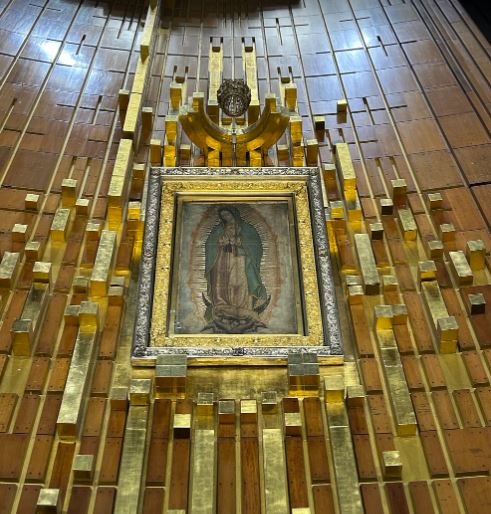
Nearly five centuries later, the tilma remains intact in the Basilica of Our Lady of Guadalupe in Mexico City. Made of cactus fiber that should have decayed within 20 years, it has survived time, weather, and even a bomb blast in 1921 that destroyed everything around it but left the tilma untouched.
For millions the tilma is more than a relic—it is a symbol of faith, resilience, and divine protection. The roses blooming in winter, the chapel’s dedication during the Christmas octave, and Mary’s words of comfort to Juan Diego all tie the miracle to the season of Christ’s birth.
At Christmas, Guadalupe reminds us that even in barren places, hope can blossom. Like roses in winter, the tilma stands as a sign that God’s light cannot be extinguished.
This story reminds us that Christmas is not only about Bethlehem but also about Tepeyac—a season when heaven touches earth, when faith blossoms in barren places, and when God’s love is revealed through a mother’s care.
Quick Facts: The Tilma of Guadalupe
• Location Today: The original tilma is preserved in the Basilica of Our Lady of Guadalupe in Mexico City.
• Material: Made of cactus fiber, which normally decays within 20 years — yet the tilma has lasted nearly 500 years.
• Pilgrimage Site: The basilica is one of the most visited Catholic shrines in the world, drawing over 20 million pilgrims annually.
• The Bomb Miracle: In 1921, a bomb hidden in flowers exploded before the tilma. Bronze candelabras were twisted and a heavy crucifix bent, but the tilma remained completely intact.
• Christmas Connection: The first chapel honoring Our Lady of Guadalupe was dedicated on December 26, 1531, during the octave of Christmas.
- Infrared Photography (Callahan, 1979): Revealed no underlying sketch or brushstrokes on the original image, indicating it wasn’t painted by human hands in the traditional sense.
- Microscopic Eye Analysis (Tonsmann, 1981): Digital amplification of the Virgin’s eyes (2500x) revealed reflections of the bishop, Juan Diego, and others present at the unveiling, exhibiting the Samson-Purkinje effect, a phenomenon of the human eye.
- Physical Anomalies: The image shows no signs of deterioration, unlike added paint and gold leaf, which have flaked off over centuries.
- https://www.youtube.com/watch?v=N4WPkYz5D_o
The Story of Juan Diego: Americas first Historically Recorded Vision of the Virgin Mary