




Testing and treatment key to turning the tide
The Texas Department of State Health Services is putting a statewide focus on congenital syphilis, a disease that has profound effects on hundreds of babies in Texas each year. Congenital syphilis cases rose from 166 in 2017 to 922 in 2022, the most recent year with final data, tracking with an increase in syphilis among adults. Texas accounted for 25 percent of the congenital syphilis cases in the United States in 2022 compared with roughly 10 percent of total births.
“These are heartbreaking statistics,” said DSHS Commissioner Jennifer Shuford, MD, MPH. “They become even more heartbreaking when you consider that congenital syphilis is preventable when moms with syphilis receive timely testing and treatment either before or early during pregnancy.”
Shuford is reaching out directly to health care professionals with a letter and video asking for their help to ensure all pregnant women are tested for syphilis three times during pregnancy as required by state law. Texas Health & Safety Code 81.090 requires screening during every pregnancy:
Syphilis is a sexually transmitted bacterial infection that can also spread from mother to child during pregnancy or at delivery. When that occurs, it can cause premature birth, low birthweight, stillbirth, deformed bones, deafness, blindness, jaundice and infant death.
Testing is critically important since syphilis can be cured with the right antibiotics. Once an infection is detected, prompt and complete treatment can reduce the chances the baby will be affected by 98 percent.
“That is where we in public health and health care can make the biggest difference in the shortest amount of time,” said Shuford. “We must find ways to increase prenatal care and the testing that goes along with it, and then make sure there is a strong connection to follow-up care.”
This Friday, DSHS will host a congenital syphilis summit in Houston, bringing together health care professionals, community health workers, health insurers, state and local public health, community groups, state agencies and others. They will gather in person and virtually, hearing from state and national experts, meeting others doing similar work in their parts of the state and returning to their communities with concrete next steps to reduce congenital syphilis among their neighbors.
Also, this week, DSHS has posted new congenital syphilis web pages that include resources for health care providers, community groups and patients. And DSHS launched a new data dashboard on congenital syphilis with information about the disease, how to identify and treat it, and recent trends and county-level data. People can find it and more public health data on the Texas Health Data section of the DSHS website.
Note: Dr. Shuford’s video is available.
-30-
(News Media Contact: Chris Van Deusen, DSHS Director of Media Relations, 512-776-7119)

Photo courtesy of Sherry Lynne
In a heartwarming pre-game ceremony, fans and attendees of the Gobbler vs. Buccaneers game on Friday night gathered to honor the legendary 1974 Gobbler team and their coaches on the 50th anniversary of their State Championship victory.

Imagine if we could travel back in time to witness the expressions on their youthful faces just moments after their epic triumph. How surreal it must have felt for them at that instant, and how pivotal that day would become.

The 1974 Gobbler team achieved a perfect 15-0 record, winning the State Championship. They had won back-to-back state championships in 1973 and 1974. They proved they could be the best, making a name for themselves, some making generational leaps that would forever change the course of their life. Their victory made a name for their school, and their city. Their hard work, dedication, and teamwork paid off, and they became legends in Cuero.

They had gathered earlier in day at the high school cafeteria before the outdoor ceremony to celebrate the anniversary of their incredible achievement. Those Gobbler boys of ’73 and ’74 now respectively, senior citizens who came from different backgrounds and walks of life, to play football. The atmosphere was filled with nostalgia and pride and the Senior Gobblers remembered how Coach Buster Gilbreth led the team to four state championship appearances within six years, secured consecutive state championships in 1973 and 1974, and established an impressive 44-game winning streak from 1973 to 1975. This streak has become the longest for any high school football team since the early 1950s and remains one of the most distinguished in the annals of high school football history.
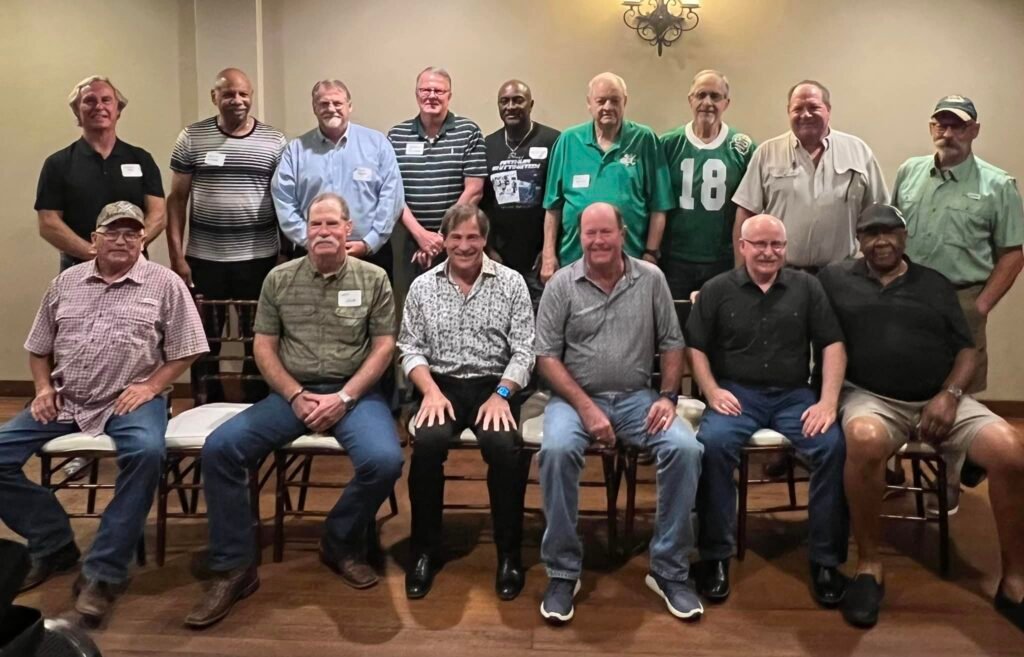

They reflected on the past and felt a pang of sadness for those who were no longer with them. They took photos, shared laughter, and enjoyed each other’s company. It was a beautiful reminder of the enduring spirit and camaraderie that defined the 1974 Gobbler State Championship team. The legacy of the 1974 Gobbler State Championship team continues to inspire and motivate future generations.


By: Pat Trevino
SOURCE: The Portal to Texas History


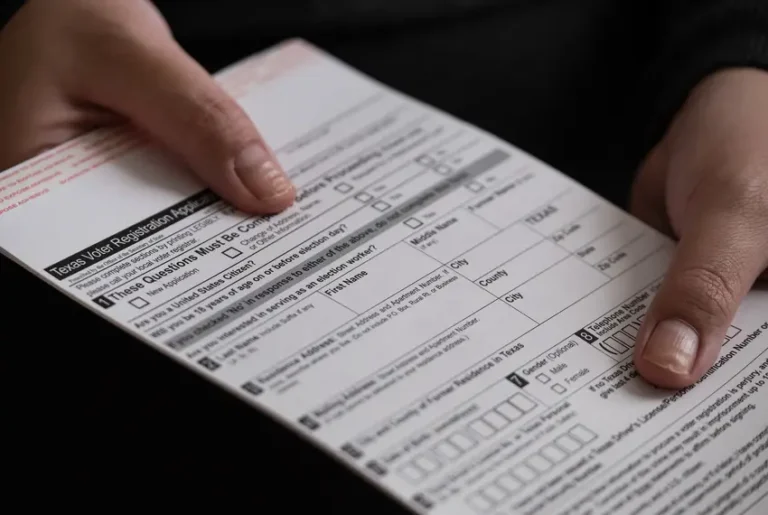
A voter registration card in 2022. The deadline to register to vote in this year’s elections is Oct. 7. Credit: May-Ying Lam for The Texas Tribune
Texas voters have less than a month to register for the Nov. 5 election.
But as county elections officials work to get more people registered, more than 1 million voters have been deemed ineligible. That includes people who moved out of state or are dead — and it’s a routine process.
Related Story
Here’s how to vote in the Texas 2024 election
“We do list maintenance every single day,” said Trudy Hancock, the Elections Administrator for Brazos County. “So you know it’s not something that’s happened just overnight and something that’s been put in place, but it is important to check your registration.”
Gov. Greg Abbott issued a press release last month touting the removal of ineligible voters, claiming some of them were possibly noncitizens. Experts quickly warned the governor’s framing could be used to undermine trust in elections. At the same time, Texas Attorney General Ken Paxton has sued to stop two urban counties from sending voter registration forms to people who are eligible to vote, claiming state law doesn’t allow that kind of outreach and it would risk adding noncitizens to the voter rolls.
Election officials have found no evidence of widespread voting by people who are not citizens in U.S. elections. In 2019, Texas incorrectly flagged 95,000 naturalized citizens for removal from the voter rolls, but backed off those previous removal attempts to settle lawsuits over the matter.
Federal law prevents states from systematically removing registered voters within 90 days of a federal election, though there are some exceptions if the voter has died, been convicted of a felony or been declared mentally incapacitated. Checking your voter registration to make sure it’s active and up to date could save you trouble at the polls. You’ll want to do that before the Oct. 7 deadline to register. It could also help us report on these issues.
Here’s how to check your voter registration. The Texas Tribune, ProPublica and Votebeat want to hear from Texas voters who believe their registrations have been erroneously canceled. Let us know if you find issues with your voter registration through the form at the bottom of this story.
Once you register to vote, you generally remain registered, but there are various reasons why you may want to verify your registration status, especially if you’ve had a name or address change. You can make those updates online here.
You can check to see if you’re registered and verify your information through the Texas Secretary of State’s website.
You’ll need one of the following three combinations to log in:
When a person submits a voter registration application, county and state officials verify the person’s eligibility using various sources, including birth and death certificates and the courts system.
Local election officials will review the application to make sure the submitted address is a residential location within the county. They share voter registration records with the state daily. The state also reviews the voter registration before it becomes effective. Registered voters are sent a registration certificate within 30 days and it becomes effective 30 days after it is submitted.
Voters receive a new certificate if they update their name or address. Otherwise, voters are sent a new certificate every two years, according to the state.
If a county voter registrar receives a nondeliverable notice after sending a voter registration certificate or receives information that there’s been an address change, a voter is placed on the state’s “suspense list” and asked to confirm their address. Sometimes this can be due to errors at the post office or when a jury summons doesn’t go to the proper address and is returned, said Trudy Hancock, the elections administrator for Brazos County.
Voters on the suspense list can still vote as normal if they update or confirm their address before the voter registration deadline or fill out a “statement of residence” when voting. But if they have moved to a different county or precinct, they may have to vote at their previous polling location or vote a limited ballot.
If a suspended voter takes no action, they are removed from the voter rolls after about four years, according to the Texas Secretary of State’s office.
You must complete and submit a paper voter registration application by Oct. 7.
You can request a postage-paid application through the mail or find one at county voter registrars’ offices and some post offices, government offices, or high schools. You can also print out the online application and mail it to the voter registrar in your county.
Applications must be postmarked by the Oct. 7 deadline. Download your application here.
Additionally, you can register to vote through the Texas Department of Public Safety while renewing your driver’s license. You may be able to register to vote online if you’re also allowed to renew your license online. This is the only form of online registration in the state.
You must reside in a Texas county by the voter registration deadline to vote in the upcoming election. Voters who are 65 or older, have a disability or will be absent during the entire voting period, such as members of the military of voters living overseas, qualify for an absentee ballot. You can read more about absentee and mail-in voting here.
If you are a registered voter but moved after the Oct. 7 deadline, you can vote at your previous polling location if you moved within the same county or political subdivision. Or you can vote at your new polling location, but the ballot will only include races available to voters in both your new and old political districts, such as statewide races. Limited ballots are available only during early voting at a “main early voting polling place.” Those are usually the office of the election administrator or county clerk who runs elections in your county. The main polling place should be noted in a county’s list of early voting locations.
If you have questions or concerns about your registration, you can find your county’s voter registration contact here.
Inside polling locations, there are typically “resolution desks” where poll workers can address registration issues. If you believe you should be registered but don’t appear on the voter registration list at the polls, you can cast a provisional ballot. There’s no guarantee that a provisional ballot will ultimately be counted. The best bet to ensure you don’t have problems is verifying your registration is active and up-to-date ahead of the Oct. 7 deadline to register to vote.
Your local voter registrar must review the provisional ballot and verify your registration within six days of the election. The registrar then passes that information to the local ballot board, which decides whether the provisional ballot is eligible to be counted under election laws, according to the Texas Secretary of State’s voter education website.
Provisional voters must be sent a notice about whether their ballot was counted no later than 10 days after the election is certified
You can also find more information on frequently asked questions from the Secretary of State’s Office at votetexas.gov.
If you need help navigating voting issues, a coalition of voting rights groups has a helpline at 866-687-8683. The Texas Secretary of State’s office has a helpline at 1-800-252-8683.
Disclosure: Texas Secretary of State has been a financial supporter of The Texas Tribune, a nonprofit, nonpartisan news organization that is funded in part by donations from members, foundations and corporate sponsors. Financial supporters play no role in the Tribune’s journalism. Find a complete list of them here.
 María Méndez
Learn about The Texas Tribune’s policies, including our partnership with The Trust Project to increase transparency in news.

The Cuero American Legion Hall is set to host a living history presentation on Saturday, September 21, 2024, at 3:00 PM. The event is organized by the Yorktown Bicentennial Chapter of the Daughters of the American Revolution, in collaboration with the DeWitt County Historical Commission.
The young actors are Max Leslie-Mees, Lauren Leslie-Mees, Cameron Batts, and Landon Schlenker. They will portray 1846 DeWitt County students, engaging in a classroom scenario where they will respond to historical inquiries. Experience history firsthand and uncover the answers to intriguing questions from the past
Event Details:
Historical Highlights:
Don’t miss this unique opportunity to experience history come to life and learn about the remarkable stories of DeWitt County’s past!
NEWS TIPS: Do you have a local news tip? Email: Ihavenewscuero@gmail.com
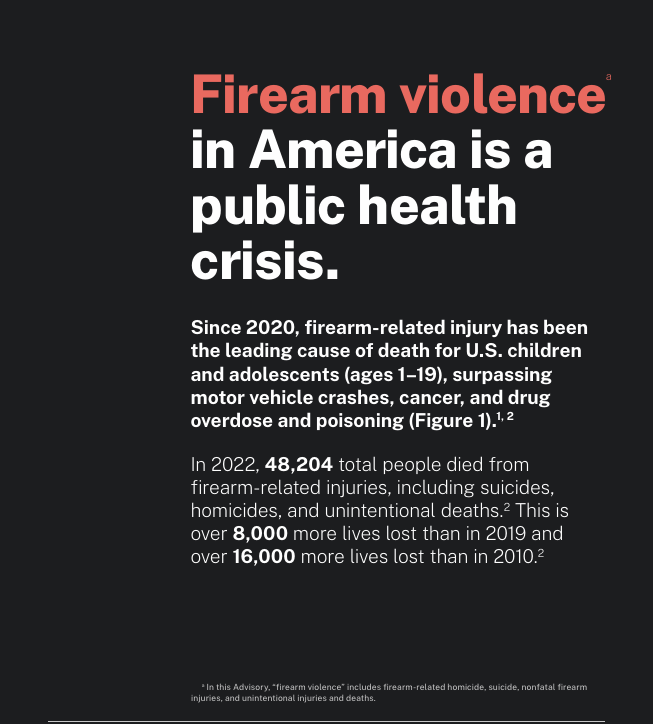
The rate of firearm‑related deaths in our nation has been rising and reached a near
three‑decade high in 2021. This crisis is being driven, in particular, by increases in
firearm‑related homicides over the last decade and firearm‑related suicides over
the last two decades. Across all firearm‑related deaths in 2022, more than half
(56.1%) were from suicide, 40.8% were from homicide, and the remaining were
from legal intervention, unintentional injuries, and injuries of unknown intent.
The age‑adjusted rate of firearm‑related suicide increased by 20.1% from 2012
(6.3 per 100,000) to 2022 (7.6 per 100,000), with an absolute increase from 20,666
to 27,032 deaths over the same period. The age‑adjusted rate of firearm‑related
homicide increased by 62.5% from 2012 (3.8 per 100,000) to 2022 (6.2 per 100,000),
with an absolute increase from 11,622 to 19,651 deaths over the same period.
Despite these increases over time in firearm‑related deaths, the number of firearm‑related homicides decreased from 20,958 (6.7 per 100,000 [age‑adjusted]) in 2021 to 19,651 (6.2 per 100,000 [age‑adjusted]) in 2022.
Furthermore, the provisional firearm‑related homicide rate for 2023 (part‑year) is lower than the rate in 2022.4 The provisional firearm‑related suicide rate for 2023 (part‑year) remains comparable to the rate in 2022. When measured over a decade (2012 to 2022), children and younger populations experienced a staggering increase in firearm‑related suicide rates: 43% for 25‑34‑year‑olds (6.5 per 100,000 [crude rate]) in 2012 to (9.3 per 100,000 [crude rate]) in 2022, 45% for 15‑24‑year‑olds (5.0 per 100,000 [crude rate]) in 2012 to (7.3 per 100,000 [crude rate]) in 2022, and 68% for children aged 10‑14 (0.50 per
100,000 [crude rate]) in 2012 to (0.84 per 100,000 [crude rate]) in 2022 (Figure 3).2
The rate of firearm-related deaths in our nation has been rising and reached a near three-decade high in 2021.
The CDC defines legal intervention as, “firearm injuries inflicted by the police or other law
enforcement agents acting in the line of duty.” The term legal intervention is a commonly used external cause of injury classification. It does not indicate the legality of the circumstances surrounding the death. (Centers for Disease Control and Prevention (2024, March). About firearm injury and death. U.S. Department of Health and Human Services. https://www.cdc.gov/firearm‑violence/about/index.html)
First published in the U.S. Surgeon General website Firearm Violence: A Public Health Crisis in America (hhs.gov)
NEWS TIPS: Do you have a local news tip? Email: Ihavenewscuero@gmail.com

By
Richard Fry
About half of U.S. adults (52%) lived in middle-income households in 2022, according to a Pew Research Center analysis of the most recent available government data. Roughly three-in-ten (28%) were in lower-income households and 19% were in upper-income households.
Our calculator below, updated with 2022 data, lets you find out which group you are in, and compares you with:
Other adults in your metropolitan area
U.S. adults overall
U.S. adults similar to you in education, age, race or ethnicity, and marital status
Find more research about the U.S. middle class on our topic page.
Our latest analysis shows that the estimated share of adults who live in middle-income households varies widely across the 254 metropolitan areas we examined, from 42% in San Jose-Sunnyvale-Santa Clara, California, to 66% in Olympia-Lacey-Tumwater, Washington. The share of adults who live in lower-income households ranges from 16% in Bismarck, North Dakota, to 46% in Laredo, Texas. The share living in upper-income households is smallest in Muskegon-Norton Shores, Michigan (8%), and greatest in San Jose-Sunnyvale-Santa Clara, California (41%).
How the income calculator works
The calculator takes your household income and adjusts it for the size of your household. The income is revised upward for households that are below average in size and downward for those of above-average size. This way, each household’s income is made equivalent to the income of a three-person household. (Three is the whole number nearest to the average size of a U.S. household, which was 2.5 people in 2023.)
Pew Research Center does not store or share any of the information you enter.
We use your size-adjusted household income and the cost of living in your area to determine your income tier. Middle-income households – those with an income that is two-thirds to double the U.S. median household income – had incomes ranging from about $56,600 to $169,800 in 2022. Lower-income households had incomes less than $56,600, and upper-income households had incomes greater than $169,800. (All figures are computed for three-person households, adjusted for the cost of living in a metropolitan area, and expressed in 2022 dollars.)
The following example illustrates how cost-of-living adjustment for a given area was calculated: Jackson, Tennessee, is a relatively inexpensive area, with a price level in 2022 that was 13.0% less than the national average. The San Francisco-Oakland-Berkeley metropolitan area in California is one of the most expensive, with a price level that was 17.9% higher than the national average. Thus, to step over the national middle-class threshold of $56,600, a household in Jackson needs an income of only about $49,200, or 13.0% less than the national threshold. But a household in the San Francisco area needs an income of about $66,700, or 17.9% more than the U.S. threshold, to be considered middle class.
The income calculator encompasses 254 of 387 metropolitan areas in the United States, as defined by the Office of Management and Budget . If you live outside of one of these 254 areas, the calculator reports the estimates for your state.
The second part of our calculator asks about your education, age, race or ethnicity, and marital status. This allows you to see how other adults who are similar to you demographically are distributed across lower-, middle- and upper-income tiers in the U.S. overall. It does not recompute your economic tier.
Note: This post and interactive calculator were originally published Dec. 9, 2015, and have been updated to reflect the Center’s new analysis. Former Senior Researcher Rakesh Kochhar and former Research Analyst Jesse Bennett also contributed to this analysis.
The Center recently published an analysis of the distribution of the American population across income tiers. In that analysis, the estimates of the overall shares in each income tier are slightly different, because it relies on a separate government data source and includes children as well as adults.
NEWS TIPS: Do you have a local news tip? Email: Ihavenewscuero@gmail.com
Cuero Online is a digital news site for the Cuero and Dewitt County area. Cuero Online provides a more detailed view of the community with news, sports, and entertainment. The voice of Cuero Texas.
Contact us: cueroonlinenews@gmail.com
© 2024 Cuero Online News