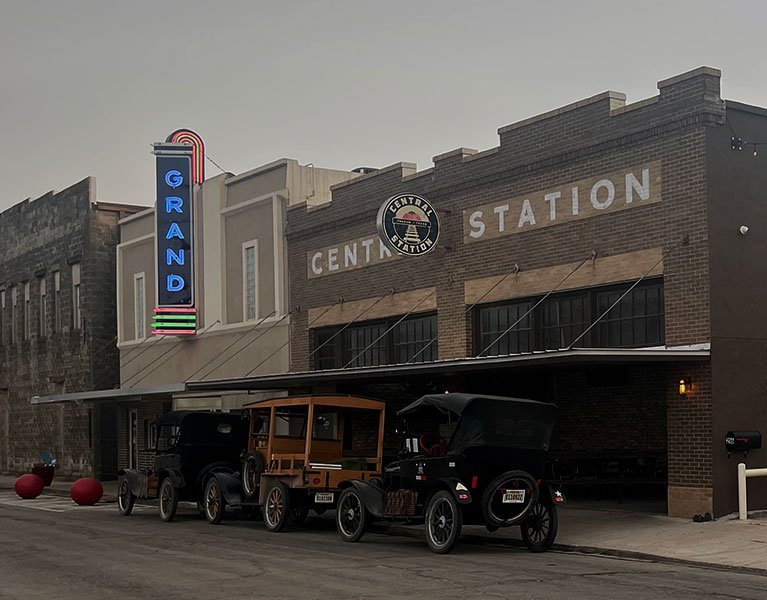
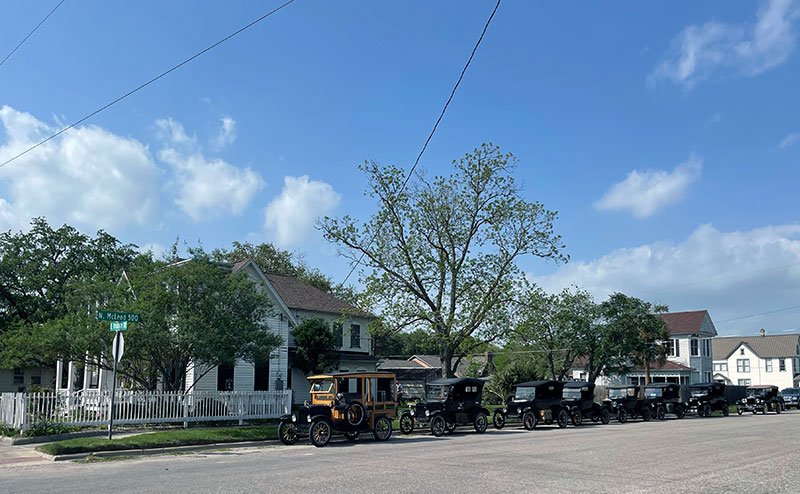
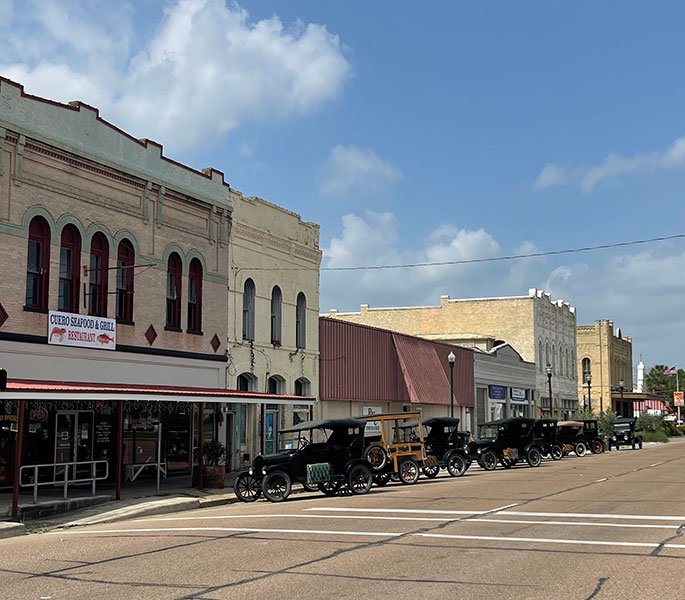
CUERO, TX – The San Antonio, Texas Model T Social Club brought history to life as they toured the streets in De Witt County and visited its storied landmarks, showcasing their fleet of meticulously maintained Ford Model T’s. Known as “The Tin Lizzies,” these vintage vehicles weren’t just a feast for the eyes—they were a rolling tribute to America’s automotive past.
Pictured in front of the De Witt County Courthouse in Cuero, Texas.
This spring tour marks Day 4 of the club’s five-day adventure, which began at the Pioneer Flight Museum near Kingsbury, Texas. Unlike a journey focused on racking up miles, this carefully curated tour brought participants to hidden gems along Texas’s backroads, with stops at historic sites, one-room schoolhouses, quaint hardware stores, and family-run eateries.
Stopping by to enjoy the blue bonnets.Central Station in Yoakum, TexasHotel in Yoakum, Texas
While in Cuero, the club embraced the town’s charm and rich history. Highlights included a stop at the DeWitt County Historical Museum, affectionately referred to as the “House Where History Lives.” The visit added another layer of nostalgia as the group learned about the area’s deep ties to Texas heritage. Among the participants was a member whose great-great-grandfather, Alsatian settler Anton Golly, was one of DeWitt County’s historical figures. This personal connection made the visit even more meaningful.
DeWitt County Historical Museum, affectionately referred to as the “House Where History Lives.”Meyersville Country Store in De Witt, Tx
The Tin Lizzies also explored other area attractions during their tour, including Indianola and St. John Lutheran Church in Meyersville. After enjoying Cuero’s hospitality and spending the night in a local hotel, the group continued their journey with visits to more museums and stops downtown.
St. John Evangelical Lutheran Church, Meyersville, De Witt County Texas
Tour organizer Carey, accompanied by his daughter Jenepher and son Brian,
Led by tour organizer Carey, accompanied by his daughter Jenepher and son Brian, the club is comprised of eleven Model T’s and their owners, all sharing a passion for celebrating the past. Each stop along the way is a testament to their mission of showcasing historical treasures that might otherwise go unnoticed.
Former Green-De Witt one room country school now used as a community center in Meyersville.
The sight of these vintage vehicles rolling through Cuero’s streets offered locals and visitors alike a once-in-a-lifetime opportunity to glimpse an era when these “Tin Lizzies” revolutionized transportation. Residents gathered to capture photos, admire the cars, and connect with the owners, whose stories and enthusiasm brought the past vividly to life
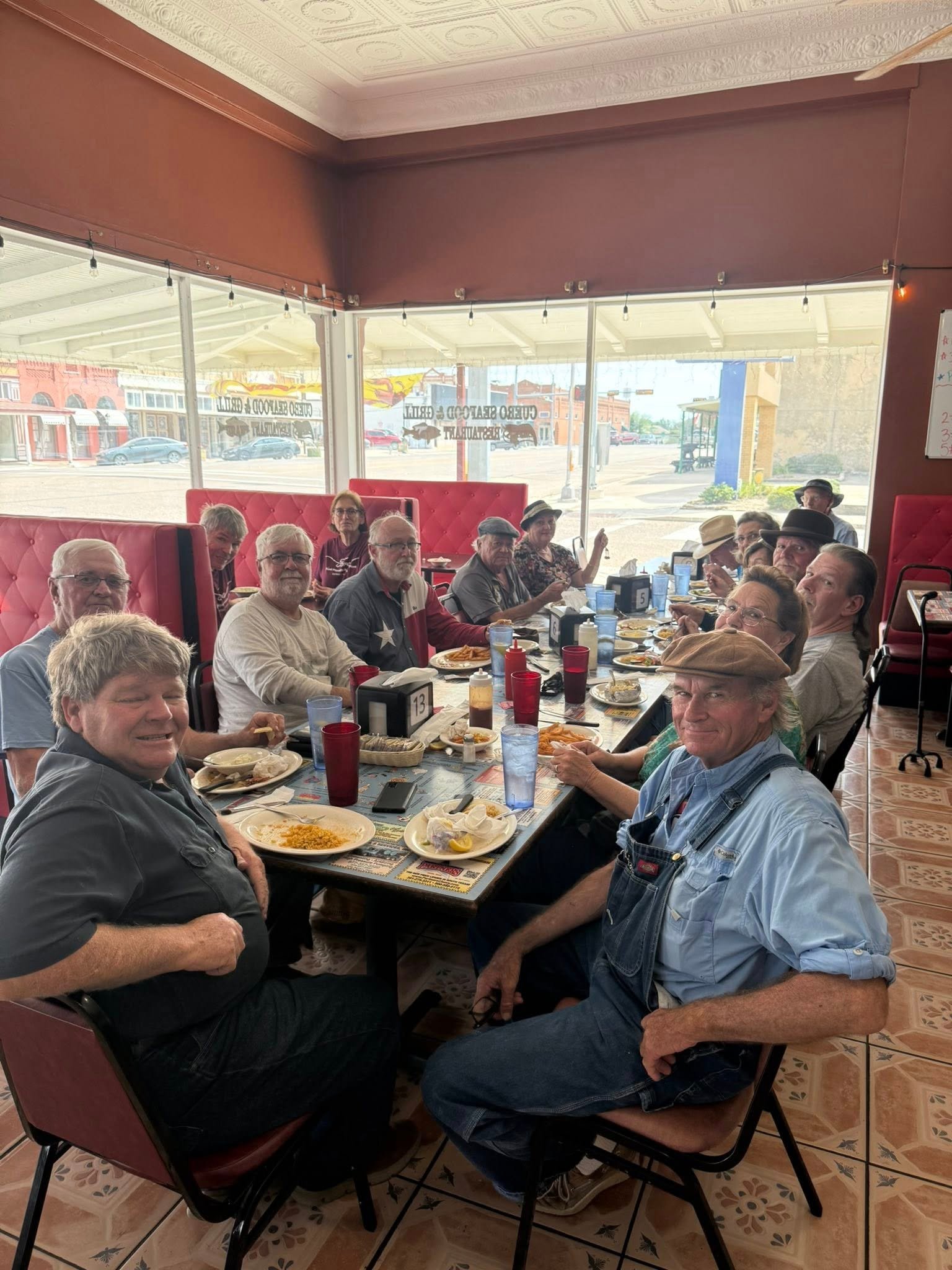
Several members stopped by to eat at the Cuero Seafood & Grill in Cuero, Tx.Members of the San Antonio Model T Club
As the Texas Model T Club continues their journey, Cuero proudly joins the list of towns that have embraced this traveling piece of history. From the unpaved backroads to the warm welcomes, this spring tour truly encapsulates the essence of the Texas experience. For Cuero, it was a day when history met heart—and left a lasting impression.
CUERO, TX – Dessert lovers, rejoice! Mad Batter Cheesecakes is rolling out the red carpet for their much-anticipated soft opening event, The Dessert Experience, this Friday, April 11, from 3 p.m. to 6 p.m. Guests are invited to indulge in an afternoon of decadence at their charming new location, 117 N Esplanade St.
The highlight of the event is the glorious return of the bakery’s famed cheesecakes, alongside an array of other divine dessert creations. Guests can enjoy their treats with limited seating available for those who wish to linger or opt for a convenient grab-and-go option.
Reservations are required to attend this exclusive soft opening, and spots are limited. To secure your place, contact Mad Batter Cheesecakes via Facebook messenger or by calling 361-935-2253.
This marks an exciting new chapter for Mad Batter Cheesecakes, as they prepare to share their newly designed space and much-loved desserts with the community. Dessert enthusiasts won’t want to miss this sweet celebration!
If you’re like me, you know the drill. You wake up with a pounding headache, itchy, watery eyes, and that relentless postnasal drip reminding you it’s that time of year again. Allergy season in Texas doesn’t just knock—it barrels in with a force that’s impossible to ignore. For those of us navigating life here, it’s not just about the sneezing and coughing; it’s a full-on battle with Mother Nature.
I was reminded of this just the other day while reflecting on a story from my high school years. Back then, we had this spot everyone called the “smoking tree.” Hard to believe now, but it was a designated area for students to smoke cigarettes—yes, really. Of course, not everyone was smoking tobacco. I remember one afternoon, walking back to class, when one of the usual characters stopped me. My eyes were red and watery (thank you, allergies), and he asked, “Hey, are you okay?” I replied, “Yeah, I’m fine, just allergies.” He paused, smirked, and said, “Yeah, I’m going to use that excuse next time!” I tried to explain that I did have allergies, but it was clear that he was already in another zone. Looking back, it’s a funny reminder of how allergies can get you side-eyed, even when you’re just trying to breathe through the season.
So, what are the common culprits causing all this misery? Living in Texas means you’ll likely face these symptoms every year:
Common Allergy Symptoms in Texas
-Sneezing (nonstop and so loud you scare the dog)
– Congestion (good luck breathing through your nose)
– Runny nose (just leave the tissues on the table)
– Itchy, watery eyes (like you’ve been crying through a sad movie)
– Postnasal drip (that lovely constant tickle in your throat)
– Coughing (thanks to said postnasal drip)
– Headaches (foggy, pounding, and relentless)
– Fatigue (it’s exhausting trying to function through all this)
What Triggers Allergies in Texas?
The truth is Texas is always in allergy season thanks to our varied climate and plant life. Here’s what you’re dealing with:
Seasonal Allergy Triggers in Texas
1. Cedar Fever (Mountain Cedar Pollen): A winter menace, especially in Central Texas, that can make you feel like you’ve caught the flu.
2. Spring Blooms: Grass, tree, and flower pollens peak during springtime, wreaking havoc on those with pollen allergies.
3. Summer Grasses: Bermuda and other grasses contribute to the misery of summer allergies.
4. Ragweed in the Fall: This pesky plant thrives in late summer and fall, sending out waves of sneezes.
Survival Tips for Texans
– Monitor Pollen Counts: Check local forecasts for allergen levels. On high-pollen days, stay indoors as much as possible.
– Keep Windows Closed: As tempting as it is to let in a breeze, it’s better to run the A/C to filter the air.
– Shower and Change Clothes: After being outdoors, rinse off pollen and put on fresh clothes to avoid spreading allergens inside.
– Use Over-the-Counter Remedies: Antihistamines, decongestants, and nasal sprays can work wonders.
– Invest in an Air Purifier: It’s a game-changer for removing allergens from your home.
– Consider Allergy Shots: For severe cases, talk to a specialist about immunotherapy options.
So here I am again, battling congestion and sneezing my way through another Texas allergy season with a box of tissues on one side and my trusty meds on the other. But I remind myself, this is just part of life here in the Lone Star State, where even the allergens seem to be as big as Texas itself.
Stay prepared, stay hydrated, and take it one sniffle at a time—we’ll get through this!
Cuero residents have a special opportunity to help shape the future of their community at an open-house workshop scheduled for Monday, April 7, 2025, from 5:00 PM to 7:00 PM. The event invites locals to come forward with ideas and insights that can contribute to making Cuero an even better place to live, work, play, and grow.
The workshop will serve as a platform for discussions, brainstorming, and sharing thoughts on how to enhance the community’s potential. Organizers are urging residents to take part in this important initiative and ensure their voices are heard.
For those unable to attend in person, participation is still possible via a quick online survey, available in both English and Spanish, at https://arcg.is/1DH8qD0 . The survey provides an accessible way for community members to contribute their ideas and feedback, no matter their schedules or circumstances.
This collaborative effort aims to pave the way for a thriving Cuero, reflecting the needs and aspirations of its residents. Make your mark on the future by attending the workshop or completing the survey. The time to act is now!
For more information, reach out to the organizers directly. Let’s come together to create lasting change and progress for Cuero!
Eloisa Corpus Mejia, originally from Yorktown, Texas, is gaining recognition as the author of inspiring Word Search Puzzle books, creatively combining devotionals and puzzles to offer readers a unique way to engage with scripture. Her acclaimed Guided by Grace series has recently expanded with the release of The Passion and Resurrection: Easter Edition, a thoughtful installment that merges faith-filled reflections with the fun of solving word search puzzles.
Mejia expressed heartfelt gratitude for the opportunity to continue spreading faith through her work, describing the experience of holding both books in her series as a true blessing. She shared her joy in knowing her creations are bringing encouragement to readers, especially during difficult times, and extended sincere thanks to everyone who has supported her by purchasing the books and leaving kind reviews on Amazon. Their encouragement, she noted, holds a special place in her heart.
By day, Mejia serves the community through her work with the United States Postal Service, but her passion for spreading faith continues to shine through her writing. Both books in Mejia’s Guided by Grace series are currently available on Amazon. They make meaningful gifts for Easter or any occasion, serving as creative tools for deepening one’s spiritual journey. With her innovative approach, Eloisa Corpus Mejia continues to uplift and inspire, leaving an indelible mark on faith-based literature through her dedication to spreading God’s Word in ways that resonate deeply with her community.
Samuel Ray Johnson, a beloved resident of Houston, Texas, passed away peacefully on Tuesday, March 25, 2025. Born on June 14, 1961, in Cuero, Texas, Samuel was the son of R.J. Johnson and Eunice Yvonne Douglas Johnson. He attended schools in Yoakum, Texas, where he built lasting friendships and cherished memories.
Samuel was a proud and devoted Dallas Cowboys fan, a passion that brought him immense joy throughout his life. He will always be remembered for his love of the team and his infectious enthusiasm for the sport.
He is preceded in death by his parents, his brother R.J. Johnson Jr., and his sister Linda Ross. Samuel is survived by his sisters: Hannah Harris (Bobby) of Corpus Christi, Paula Gates (Pastor Gates) of Yoakum, Brenda Brown of Corpus Christi, Theresa Johnson of Houston, Texas, and Cynthia Littles (Alfred) of Corpus Christi, and Rubye Johnson of Los Angeles, California,
A memorial service honoring Samuel’s life was held on Saturday, April 5, 2025, from 10:30 a.m. to 11:30 a.m. at Beth Elder Baptist Church, located at 201 Huck St., Yoakum, Texas. Pastor Boston Lynn Gates officiated the heartfelt service, bringing together family and friends to celebrate Samuel’s legacy.
Samuel Ray Johnson will be deeply missed by his loved ones and all who had the pleasure of knowing him. May his memory continue to live on in the hearts of those he touched.
Martin Leske, a fifth-generation Cuero resident and accomplished business leader, has announced his intent to seek re-election for the position of DeWitt County Hospital Trustee. With a proven track record in entrepreneurship and community service, Leske aims to continue leveraging his extensive experience to ensure the ongoing success of healthcare services in the region.
Leske graduated from Cuero High School in 2000 and earned dual degrees in Finance and Economics from Texas Tech University in 2004, followed by an MBA in 2016. He and his wife, Kailey Slone, also a Cuero native, have been married since 2012 and reside in Cuero with their two children.
Professionally, Leske has built a career marked by innovation and leadership. In 2011, he founded a commercial trucking and logistics business, which he later sold to RelaDyne, a national conglomerate, in 2019. Currently serving as Regional Operations Manager for Sun Coast Resources, a RelaDyne Company, Leske oversees operations across Texas and southeastern New Mexico, managing 11 terminals, a $68 million EBITDA portfolio, and approximately 700 associates. In addition to his corporate role, he owns businesses in commercial real estate and heavy equipment rental.
Leske’s commitment to community service is evident in his involvement with the DeWitt Medical Foundation, where he served as President for six years and is now Vice President. Under his leadership, the foundation tripled its endowment and contributed over $500,000 toward hospital improvements, including education, equipment, and capital expenditures. He also serves on the Cuero Community Foundation, further demonstrating his dedication to the local community.
As a Hospital Trustee, Leske has prioritized maintaining the hospital’s financial stability, recruiting and retaining top medical personnel, and ensuring access to high-quality healthcare for all residents. He emphasizes the importance of addressing challenges through strategic problem-solving, focusing on people, processes, and communication to meet the community’s needs effectively.
By seeking re-election, Leske reaffirms his commitment to preserving and enhancing healthcare services in DeWitt County. His extensive professional and community experience positions him as a strong advocate for the hospital’s continued success and its role as a cornerstone of the local economy and well-being.
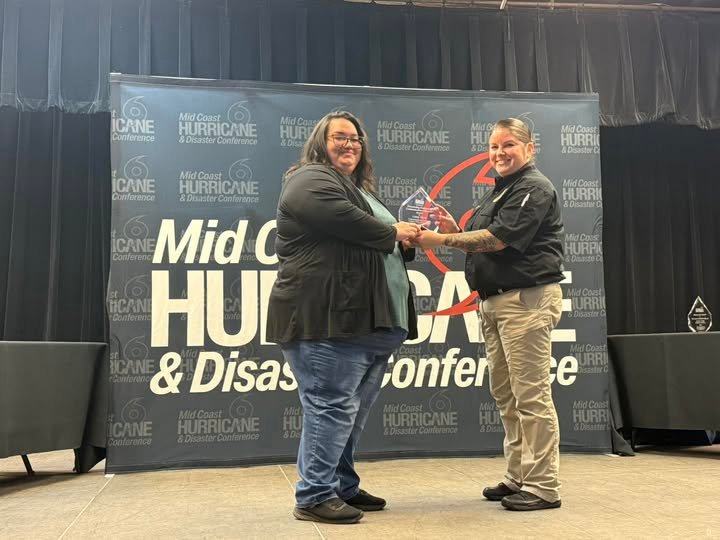
Yoakum, Texas – Lenzy Meza, Communications Supervisor for the Yoakum Police Department, has been awarded the prestigious Outstanding Emergency Communications Operator Award at the 2025 MidCoast Hurricane & Disaster Conference. The award, presented earlier today, recognizes Meza’s exemplary dedication and exceptional service in the field of emergency communications.
Known as the steady and calm voice behind the radio, Meza has earned the respect and admiration of her colleagues for her professionalism, composure, and commitment to the vital work of emergency dispatch. Her role as Communications Supervisor has been integral to ensuring efficient and effective communication during critical situations, contributing to the safety and well-being of the Yoakum community.
The Yoakum Police Department expressed immense pride in Meza’s achievement, describing her as a cornerstone of their operations. Her dedication and hard work serve as an inspiration not only to her colleagues but also to others in the field of emergency response.
The 2025 MidCoast Hurricane & Disaster Conference brings together professionals and leaders from across the region to discuss disaster preparedness and response. The Outstanding Emergency Communications Operator Award highlights the importance of the often unseen but crucial role of dispatchers in emergency situations.
Eva Jo Zapalac Aschen, 76, of Cuero peacefully passed away on Monday, March 31, 2025, in Luling. She was born December 31, 1948, in Shiner to William and Marie Malinovsky Zapalac. She worked as an Assistant Manager at Bottom Dollar, a Secretary at St. Michael’s Catholic Church and was an employee for several home healthcare agencies. She was a member of the Altar Society and Parishioner at St. Michael’s Catholic Church and a member of St. Ann’s Society 37 Hochheim KJZT.
She is survived by her sons, Ronald G. Aschen Jr. (Diane) and Eric Aschen (Michelle); sisters, Willa Mae Zimmermann (Harry), Bonnie Moeller (John) and Lana Fellers (Clint); brother, Otto Koliba (Barbara); grandchildren, Hunter Aschen, Skylar Aschen, Thomas Aschen, Cammron Anderson, Dustin Anderson, McKenzie Vela, Colyn Anderson and Lucas Anderson; as well as many nieces and nephews.
She was preceded in death by her parents.
Visitation will be held Sunday, April 6, 2025, 4:00 to 6:00 PM with a rosary to be recited at 5:30 PM at Freund Funeral Home. Funeral Mass will be held Monday, April 7, 2025, 10:00 AM at St. Michael’s Catholic Church with Father Jacob Mendoza officiating. Interment will follow at St. Ann’s Catholic Cemetery in Yoakum.
Pallbearers include Hunter Aschen, Thomas Aschen, Colyn Anderson, Chase Fellers, Otto Koliba II, Jason Moeller, Dwayne Zimmermann and Ray Stehling.
The Honorary Pallbearer includes Skylar Aschen.
Memorial Contributions may be made to St. Michael’s Catholic Church Building Fund or St. Ann’s Building Fund.
You may sign the guestbook or send condolences at www.freundfuneralhome.com.
WASHINGTON (AP) — President Donald Trump on Tuesday downplayed the texting of sensitive plans for a military strike against Yemen’s Houthis this month to a group chat that included a journalist, saying it was “the only glitch in two months” of his administration as Democratic lawmakers heaped criticism on the administration for handling highly sensitive information carelessly.
Trump told NBC News that the lapse “turned out not to be a serious one,” and expressed his continued support for national security adviser Mike Waltz.
Waltz, according to an article posted online Monday by The Atlantic, appeared to have mistakenly added the magazine’s editor-in-chief, Jeffrey Goldberg, to a chat that included 18 senior administration officials discussing planning for the strike.
“Michael Waltz has learned a lesson, and he’s a good man,” Trump said. He also appeared to point blame on an unnamed Waltz aide for Goldberg being added to the chain. “It was one of Michael’s people on the phone. A staffer had his number on there.”
But the use of messaging app Signal to discuss a sensitive operation has opened the administration to blistering criticism from Democratic lawmakers who expressed outrage at the White House’s and senior administration officials’ insistence that no classified information was shared. Senior administration officials have struggled to explain why the publicly available app was used to discuss such a delicate matter.
Waltz makes his first public comments
Waltz said Tuesday he was not sure how Goldberg ended up on the chat.
“This one in particular, I’ve never met, don’t know, never communicated with,” Waltz said.
Later Tuesday, Waltz said in an appearance on Fox News Channel’s “The Ingraham Angle” that he built the message chain and that White House technical experts were trying to figure out how Goldberg’s contact “may have been sucked in.”
“We made a mistake. We’re moving forward,” said Waltz, who added that he took “full responsibility” for the episode.
White House National Security Adviser Mike Waltz listens to a question from a reporter in the James Brady Press Briefing Room at the White House, in Washington, Feb. 20, 2025. (AP Photo/Alex Brandon, file)
Trump, for his part, continued to attack The Atlantic and Goldberg and sent mixed messages on whether the administration would change how it goes about sharing sensitive information going forward.
“We won’t be using it very much” in the future, Trump said of Signal. “That’s one of the prices you pay when you’re not sitting in the Situation Room with no phones on, which is always the best, frankly.”
Trump added, “If it was up to me everybody would be sitting in a room together. The room would have solid lead walls and a lead ceiling and lead floor.”
One official reported to be on the Signal chain, Director of National Intelligence Tulsi Gabbard, acknowledged during a Senate Intelligence Committee hearing on Tuesday that she was traveling overseas during the exchange. She wouldn’t say whether she was using her personal or government-issued phone because the matter is under review by the White House National Security Council.
One Democrat calls the mistake ‘an embarrassment’
Both Gabbard and CIA Director John Ratcliffe, who also was a participant in the Signal exchange and also testified at Tuesday’s intelligence hearing, faced blistering criticism from lawmakers.
“Director Ratcliffe, this was a huge mistake, correct?” Sen. Jon Ossoff, a Georgia Democrat, asked.
After a brief pause, Ratcliffe shook his head. “No,” he said.
Ratcliffe attempted to interject as Ossoff asked a follow-up question, leading the two men to speak over each other.
“This is an embarrassment,” Ossoff said, silencing Ratcliffe. “This is utterly unprofessional. There’s been no apology. There has been no recognition of the gravity of this error.”
CIA Director John Ratcliffe, joined at center by Director of National Intelligence Tulsi Gabbard, testifies as the Senate Intelligence Committee holds its worldwide threats hearing, on Capitol Hill in Washington, Tuesday, March 25, 2025. (AP Photo/J. Scott Applewhite)
In the run-up to his 2016 election victory over Democrat Hillary Clinton, Trump urged criminal prosecution of the former secretary of state for communicating about classified information with her aides on a private email server she set up. The matter was investigated, but the FBI ultimately recommended against charges. None were brought.
Clinton was among Democrats this week to criticize Trump administration officials’ use of Signal.
“You have got to be kidding me,” Clinton said in an X post that spotlighted The Atlantic article and included an eyes emoji.
Trump also faced charges for mishandling classified information at his Mar-a-Lago resort following his first White House term. Those charges were later dismissed.
Administration says Democrats shouldn’t be outraged
But on Tuesday, top administration officials were insistent the Democratic outrage was misplaced.
Ratcliffe and Gabbard told lawmakers that no classified information was included in the texts about U.S. attack plans in the message chain.
But The Atlantic reported that the messages included precise information about weapons packages, targets and timing, but did not publish those details.
Pressed on whether such information should be classified, Gabbard hedged. “I defer to the secretary of defense, the National Security Council, on that question,” she said.
Ratcliffe in one exchange with lawmakers said Defense Secretary Pete Hegseth held the authority on determining whether the information in the message chain was classified.
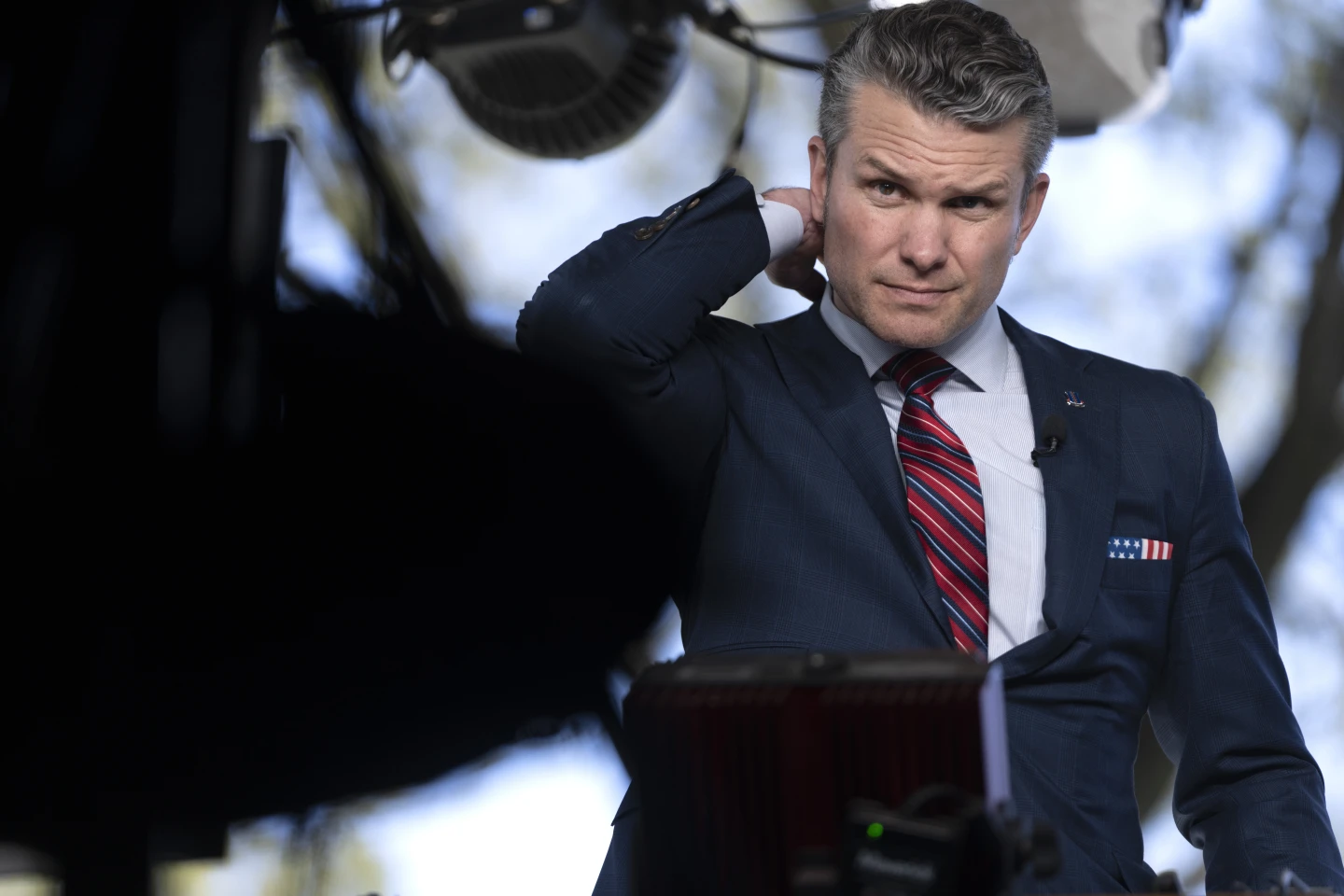
Hegseth has dodged questions about whether the information he put in a Signal chat was classified. On Tuesday while in Hawaii, he repeated almost word for word his short statement from the day before that “nobody’s texting war plans, and that’s all I have to say about that.”
Democrats pushed back, saying the leaked military plans show a sloppy disregard for security, but Ratcliffe insisted no rules were violated.
My communications to be clear in the Signal message group were entirely permissible and lawful and did not include classified information,” Ratcliffe told lawmakers in the hearing that was supposed to be focused on global security threats.
Facing heated questions from Democratic Sen. Mark Warner of Virginia, Gabbard said there’s a difference between “inadvertent” releases of information and intentional leaks. “There was no classified material that was shared,” Gabbard said.
Warner, though, said the lapse in security could have cost lives.
“If this information had gotten out, American lives could have been lost. If the Houthis had this information they could reposition their defensive systems,” Warner said.
Waltz in his appearance on Fox said that while all the information in the exchange was unclassified he’d prefer it remain out of the public eye. “I certainly want our deliberations to stay confidential,” he said.
Calls for an investigation
In response to questions from Democratic Sen. Ron Wyden of Oregon, Gabbard and Ratcliffe said they would participate in an audit looking into administration officials’ use of Signal. Wyden said it must be investigated.
“I’m of the view that there ought to be resignations,” Wyden said.
FBI Director Kash Patel, appearing with Ratcliffe and Gabbard at the hearing, said he was only recently briefed on the Signal chat matter and doesn’t have an update on whether the FBI has opened an investigation into it. Warner asked for an update by the end of the day.
Director of National Intelligence Tulsi Gabbard, center, is flanked by FBI Director Kash Patel, left, and CIA Director John Ratcliffe, as the Senate Intelligence Committee holds its worldwide threats hearing, on Capitol Hill in Washington, Tuesday, March 25, 2025. (AP Photo/J. Scott Applewhite)
The White House in a statement Tuesday called the uproar a “coordinated effort to distract from the successful actions taken by President Trump and his administration to make America’s enemies pay and keep Americans safe.”
Examining the security of Signal
Signal is an app that can be used for direct messaging and group chats as well as phone and video calls. It uses end-to-end encryption for its messaging and calling services that prevents any third party from viewing conversation content or listening in on calls.
In other words, messages and calls sent on Signal are scrambled; only the sender and recipient at each end will have the key to decipher them.
Signal’s encryption protocol is open source, meaning that it’s freely available for anyone to inspect, use or modify. The encryption protocol is also used by another popular chat service, social media company Meta’s WhatsApp platform.
Government officials have used Signal for organizational correspondence, such as scheduling sensitive meetings.
Sen. Angus King, a Maine Independent, said he was flummoxed by Ratcliffe and Gabbard’s assertion that no classified information was included in the chat.
“It’s hard for me to believe that targets and timing and weapons would not have been classified,” he said.
___
AP writer Kelvin Chan in London and Darlene Superville contributed reporting.