The Culpepper & Merriweather Circus is coming to Yoakum TOMORROW (Thursday – 10/17) If you’ve never been, this is a must-see family event. Expect trapeze artists, bareback riders, foot jugglers, big cats and much more!!
9:30am – Tent Raising & Tour
Watch the big top rise as you get a glimpse of ‘behind the scenes’ circus action. Learn about life on the road and the care that their animals receive.
Open to ALL and FREE of charge!
4pm – Midway Opens
•Enjoy pony rides, a moon bounce, giant slide, face-painting, concession stand as you prepare for the (greatest) show.
Purchase tickets for attractions.
5 & 7:30pm – Circus Performances
•Expect a world of entertainment for the entire family! Each show lasts 90 minutes.
Yoakum Golf Association BBQ Brisket Plates THIS SUNDAY – Tickets Available at Golf Course, Crossroads Bank, Yoakum National Bank, Mechanism Exchange, House of Style & Jewels.
As lawmakers and educators crack down on cellphone use in schools, most Americans back bans on using phones in classrooms but are less supportive of full-day restrictions.
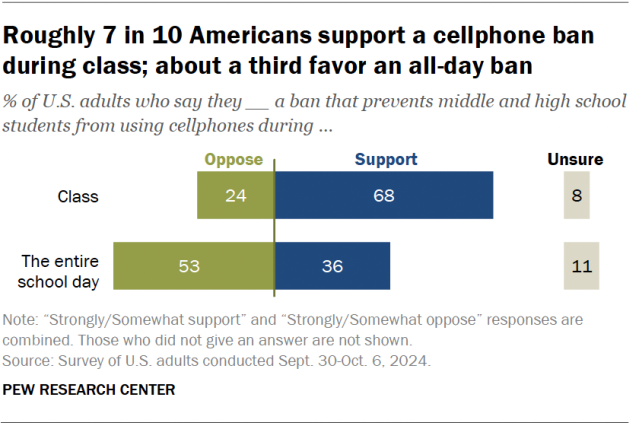
Overall, 68% of U.S. adults say they support a ban on middle and high school students using cellphones during class, according to a Pew Research Center survey conducted Sept. 30-Oct. 6, 2024. This includes 45% who strongly support this.
Another 24% oppose this, while 8% say they aren’t sure.
Some school districts have called for banning cellphone use entirely, not just during class. Our survey finds the public is far less supportive of a full-day ban on cellphone use than a classroom ban.
About one-third (36%) support banning middle and high school students from using cellphones during the entire school day, including at lunch as well as during and between classes. By comparison, 53% oppose this more restrictive approach.
Jump to read more about why Americans support or oppose classroom cellphone bans.
Views by age
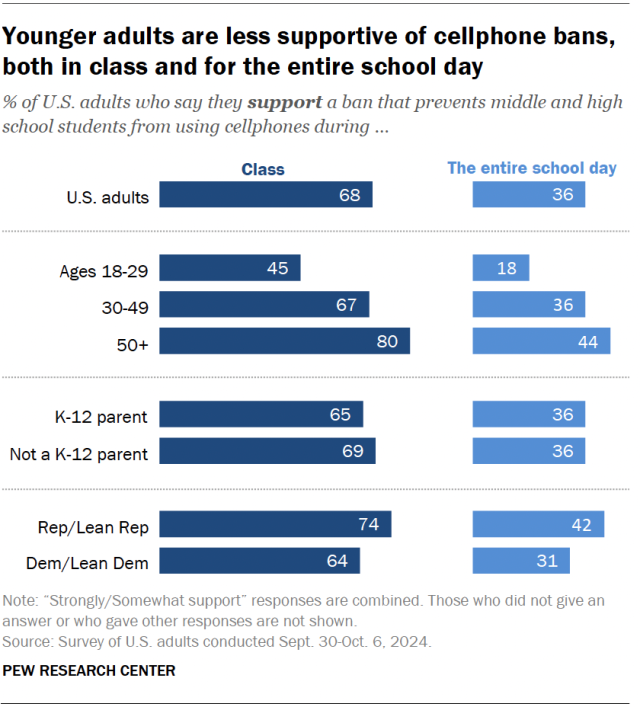
Young adults are less likely than older age groups to support a cellphone ban in middle or high school, either during class or the entire school day.
Less than half of adults under 30 (45%) say they support banning students from using cellphones during class. This share rises to 67% among those ages 30 to 49 and 80% among those ages 50 and older.
There are similar age differences in views about daylong cellphone bans. Only 18% of adults under 30 support preventing students from using cellphones throughout the school day. By comparison, 36% of those ages 30 to 49 and 44% of those 50 and older favor this type of ban.
Views by whether someone is a K-12 parent
While some media headlines focus on parents’ resistance to cellphone bans, our survey shows few differences in views between those who have school-age children and those who don’t.
For example, 65% of parents with a K-12 child support banning students from using their cellphone during class. This compares with 69% of those without children in these grades. And identical shares (36% each) support a ban for the entire school day.
Views by party
Majorities of Republicans and Democrats – including independents who lean toward either party – favor banning students from using cellphones during class. Still, support is somewhat higher among Republicans than Democrats (74% vs. 64%).
A similar pattern exists for views on bans that span the entire school day. While 42% of Republicans back full-day restrictions, 31% of Democrats do.
Why Americans support cellphone bans during class
We also asked people about possible reasons they support or oppose a cellphone ban.
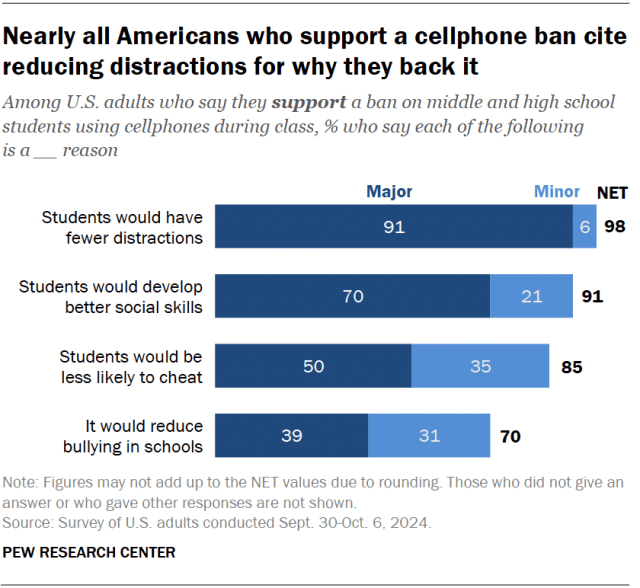
Among those who support a ban during class, nearly all (98%) say a reason they back it is because students would have fewer distractions in class. This includes a whopping 91% who say it’s a major reason. Previous Center findings show that most U.S. high school teachers say cellphone distractions are a major problem in their class.
Majorities of supporters also point to each of the other reasons we asked about. But fewer describe each as a major reason. Among those who support a ban:
70% say a major reason is students would develop better social skills.
50% say a major reason is students would be less likely to cheat.
39% say a major reason is it would reduce bullying in schools.
There are only modest differences by age and political party in the shares of people who cite each of these as major reasons.
Views by whether someone is a K-12 parent
The only reason where parents of K-12 students differ from those who are not K-12 parents is bullying. Among cellphone ban supporters, 44% of K-12 parents say a major reason they favor it is that it would reduce bullying in schools, compared with 37% of those who are not K-12 parents.
Why Americans oppose cellphone bans during class
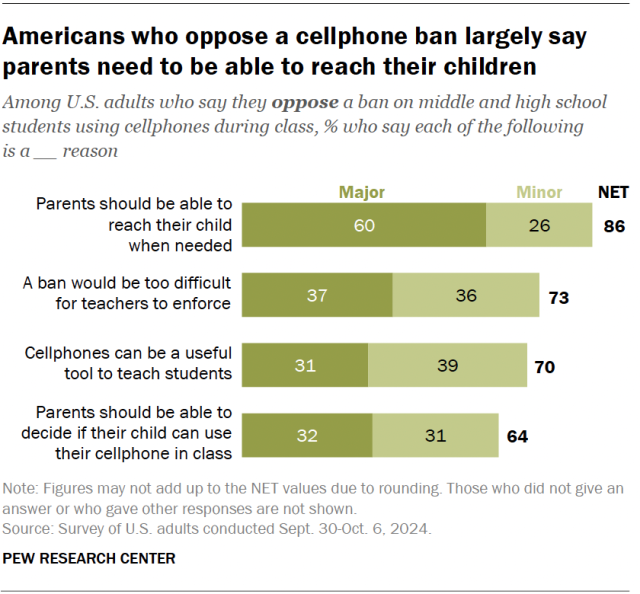
Of those who oppose a ban, majorities cite each of the four reasons we asked about. Six-in-ten – the highest share for any reason we asked about – say a major reason they oppose a ban is because parents should be able to reach their child when needed. Another 26% say this is a minor reason they oppose cellphone bans during class.
Looking at the three other reasons we asked about:
37% say a major reason is that it would be too difficult for teachers to enforce.
32% say a major reason is parents should decide if their child can use their cellphone in class.
31% say a major reason is that cellphones can be a useful tool for teaching.
Views by whether someone is a K-12 parent
Parents of K-12 students are especially likely to stress a parent’s ability to reach their child. Among opponents of a ban, most K-12 parents (70%) say this is a major reason. This share drops to 57% among those who are not K-12 parents.
K-12 parents are also more likely than their peers to say that a major reason they oppose a cellphone ban is that parents should be the ones who decide (41% vs. 30%).
Views by age
Among those who oppose a ban, older Americans are less likely than younger adults to cite three of the reasons we asked about:
45% of those ages 50 and older say a major reason is that parents should be able to reach their child. That compares with 68% of 18- to 29-year-olds and 63% of 30- to 49-year-olds.
26% of those ages 50 and older say a major reason is that parents should decide, compared with 35% each among those under 30 and those ages 30 to 49.
24% of those ages 50 and older say a major reason is that cellphones can be a useful teaching tool, compared with 35% of those ages 18 to 29 and 34% of those ages 30 to 49.
Views by party
Democrats are more likely than Republicans to point to parents being able to reach their child as a major reason for opposing a ban. Among opponents of a ban, 65% of Democrats say this, compared with 52% of Republicans. Democrats are also more likely to cite cellphones being a useful teaching tool as a major reason (35% vs. 27%).
Monica Anderson is a director of research at Pew Research Center.
Jeffrey Gottfried is an associate director focusing on internet and technology research at Pew Research Center.
Eugenie Park is a research assistant at Pew Research Center
A recent Texas law has introduced additional restrictions on the books that students can borrow from school libraries, with local bans gaining momentum in districts throughout the state.
The Texas Tribune reports that the Katy school board banned 14 titles including popular books by Dr. Seuss and Judy Blume, along with an award-winning children’s book “No, David!”. The district is aiming to control depictions of nudity; it has recently forbidden a book about a crayon that becomes “naked” after losing its wrapper.
This year continues the trend of book banning in Texas, with a new law mandating that booksellers rate public school library books for sexual content. Books deemed “patently offensive” will receive a “sexually explicit” rating, prohibiting their sale to schools and necessitating their removal from school library shelves. Meanwhile, books that generally reference or depict sex will be labeled “sexually relevant,” requiring parental consent for student access.
This new Texas law was challenged by a judge in Austin on September 18, who stopped the law from starting. The judge said the rules for booksellers were too unclear and didn’t properly address what counts as obscene.
U.S. District Judge Alan Albright issued a written order to block the enactment of a law passed this spring. He stated, “And the state,” he wrote, “in abdicating its responsibility to protect children, forces private individuals and corporations into compliance with an unconstitutional law that violates the First Amendment.”
A week later the judge’s ruling was blocked temporarily allowing the law to go into effect while the court considers the case.
Book banning has increased in the state of Texas prompting an investigation by the U.S. Department of Educaton in one school district after the superintendent was secretly recorded ordering librarians to remove library books with LGBTQ+themes. The investigation remains open as the Department of Education Office of Civil Rights, a department Trump has vowed to get rid says they are committed to supporting students of all backgrounds.
The 66Th Annual Yorktown Western Days is a 3-day festival which kicks off on Friday, October 18, 2024 with the children’s parade on main street starting at 5:30pm.
Ignorance of the law is no excuse even if it’s for a good cause like Norma’s House. The law is the law, and everyone must oblige! Norma’s House is a non-profit entity committed to assisting children who have experienced family violence and neglect. Norma’s House broke the law when they decided to open its doors in a residentially zoned area instead of a commercial area.
The purpose of zoning laws is to ensure public safety, health, and the general welfare of a community by managing factors like density, traffic, and access to amenities. Zoning also helps maintain property values by ensuring consistency in the character of a neighborhood, preventing incompatible land uses from impacting surrounding properties.
On the agenda for the October 14, 2024, Cuero City Council meeting, was the discussion and consideration for a conditional use permit for Norma’s House located on Hunt Street. What began as a seemingly routine and innocuous council meeting to discuss the conditional zoning permit for Norma’s House quickly escalated into a contentious issue.
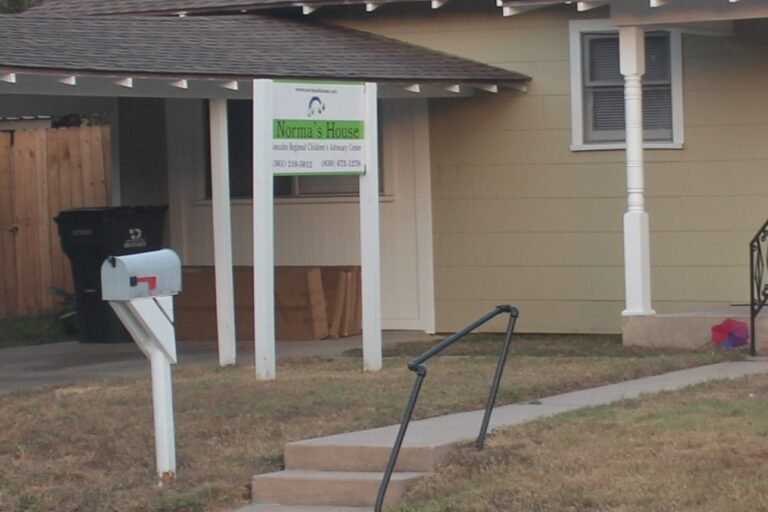
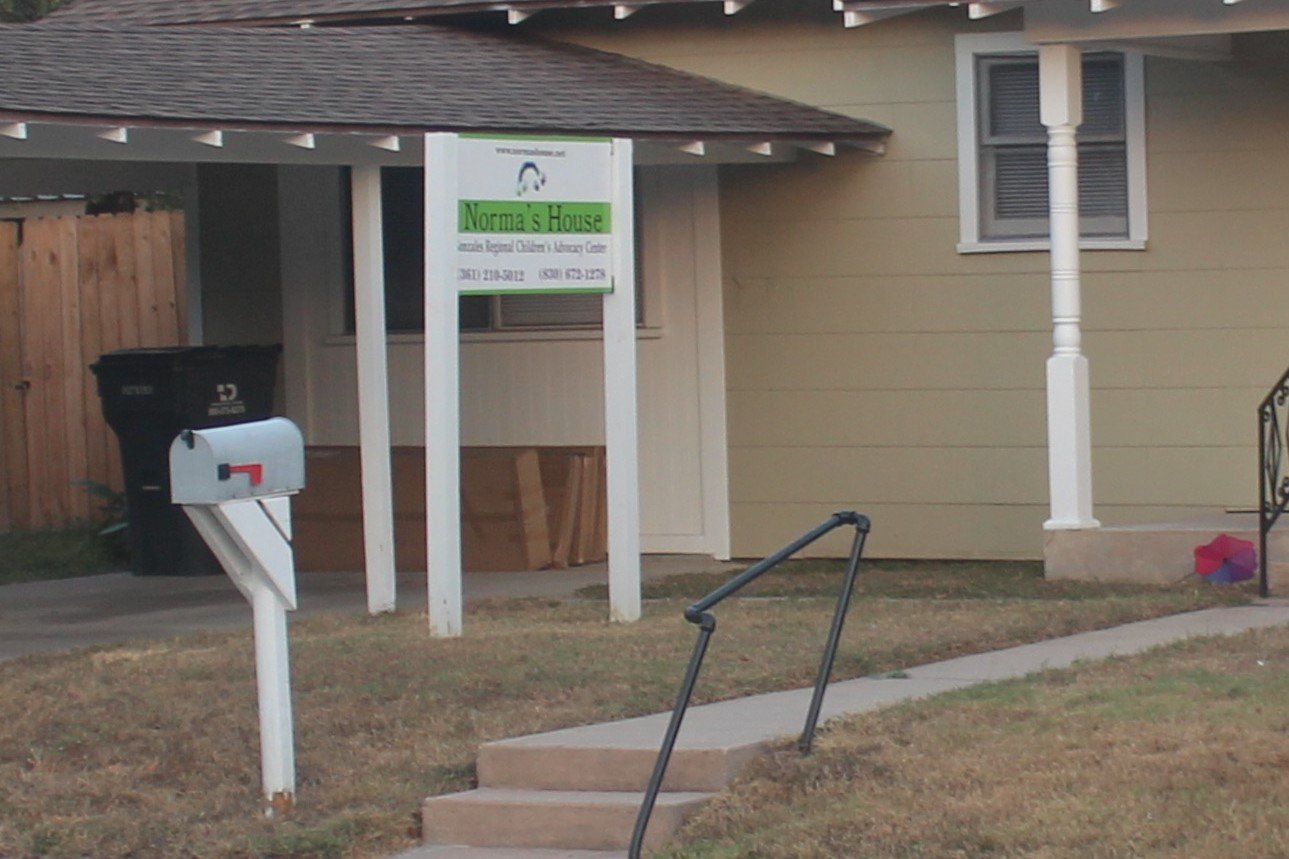
In the quiet residential neighborhood of Hunt Street in front of Norma’s House a prominent sign advertises the facility, which serves as the new home for the nonprofit organization. The situation has ignited tensions among residents who are grappling with the implications of having such a facility in their community.
According to the manager of Norma’s House they want to offer children a comforting environment that feels more like a home. The facility is designed to help children who have experienced trauma, providing them with the support they need during difficult times. However, the organization’s decision to operate in a residential area without the proper permits has raised significant concerns among local residents.
The neighborhood, primarily composed of families and long-term residents, is understandably apprehensive about the implications of having a nonprofit that deals with sensitive issues such as child abuse and neglect in their midst.
Homeowners fear that the presence of Norma’s House could negatively impact property values. While they recognize the importance of the organization’s mission, the potential for decreased property worth creates a conflict between community welfare and personal financial stakes.
A signed petition titled, “Stop the commercialization of our neighborhood” was presented to the City Council, but the specific contents of the petition have not been disclosed to the public. Several homeowners who live in the neighborhood went before the council to voice their concerns placing blame on the landlord of the property because there was a lack of transparency which has fueled unease and suspicion, with some residents believing that the organization should be relocated to a more appropriate area.
The association with police and Child Protective Services brings a level of concern about crime that the facility might draw individuals who could disturb the tranquility and safety of the neighborhood, even though the organization’s purpose is to assist children in need.
The controversy has led to heightened emotions and division against certain parties. Name-calling and heated discussions have emerged, complicating what could have been a collaborative dialogue about community needs and the importance of supporting vulnerable populations.
In response to the backlash, the management of Norma’s House has emphasized that the facility is not open to the general public. If a child or family is in need they can’t just walk up to the facility and ask for help. They operate through referrals from Child Protective Services or the Police Department. They also offered to remove the sign in front of the house.
Crime in relation to nonprofit organizations like Norma’s House are not unfounded, though they often stem from misconceptions. According to the Texas Department of Public Safety, areas with community support initiatives often see an overall reduction in crime rates, as these programs can lead to improved social conditions. However, specific statistics regarding the direct impact of similar facilities on crime in residential neighborhoods are limited, making it difficult to provide concrete reassurances to concerned residents.
The situation surrounding Norma’s House exemplifies the complex dynamics between community welfare and residential concerns. While the mission to support children in need is undoubtedly noble, the lack of communication and proper permits has led to a fractured community.
The Cuero City Council has deferred their decision on the permit issue, opting to conduct a more thorough review.
It is crucial for both Norma’s House and neighborhood residents to engage in open dialogue, addressing concerns while fostering a collaborative spirit that prioritizes the well-being of children without compromising the integrity of the community. As this story continues to unfold, it serves as a reminder of the delicate balance between compassion and community dynamics in the face of pressing social issues.
Pat Trevino Freelance Blog Writer, Photographer, Published Author
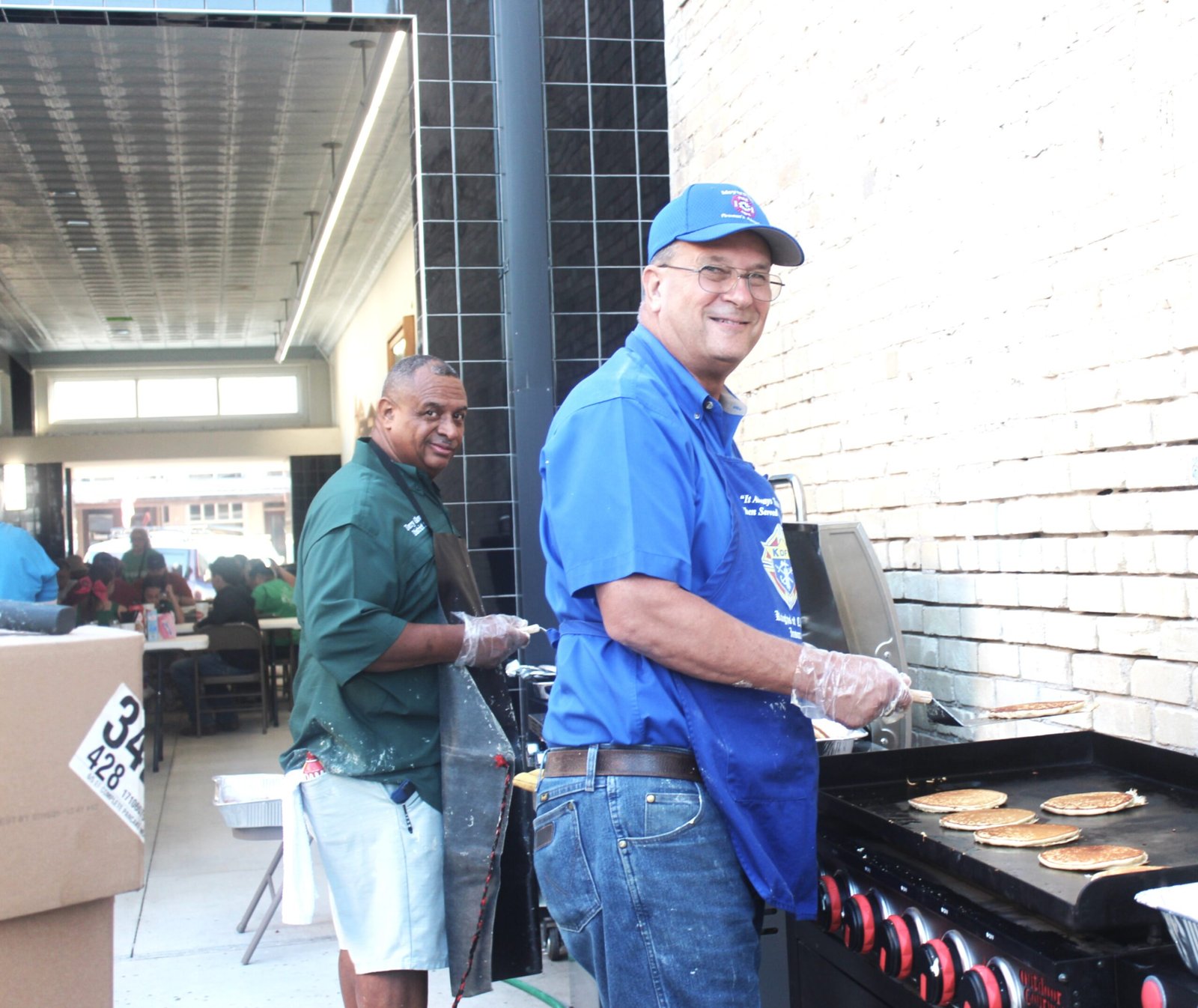
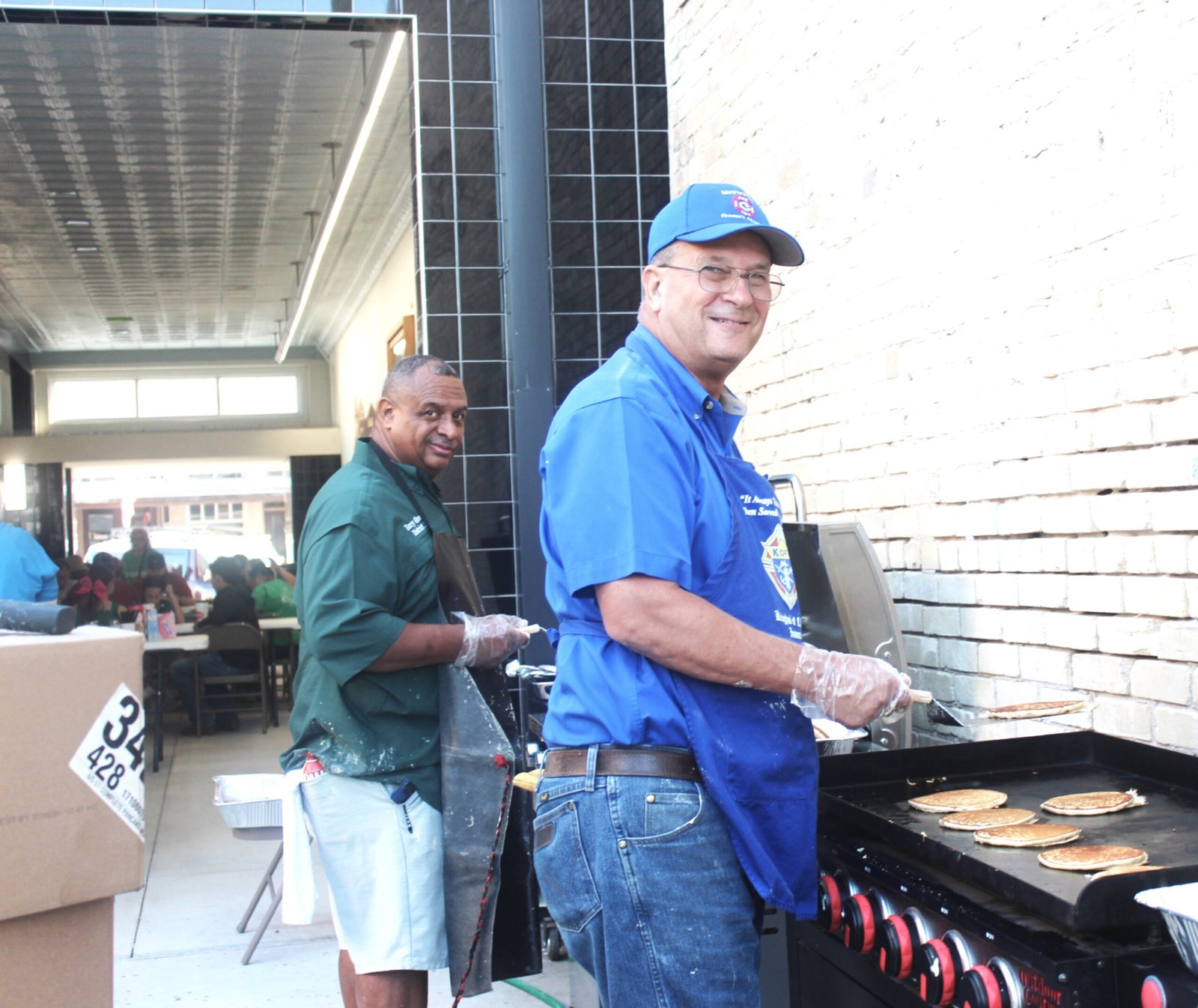
CITIZEN POLICE ACADEMY ALUMNI AND CUERO VOLUNTEER FIRE DEPARTMENT CO-SPONSOR DOWNTOWN PANCAKE BREAKFAST
(Photo by Pat Trevino) Left to Right – Terry Glover and Nicholas Taylor
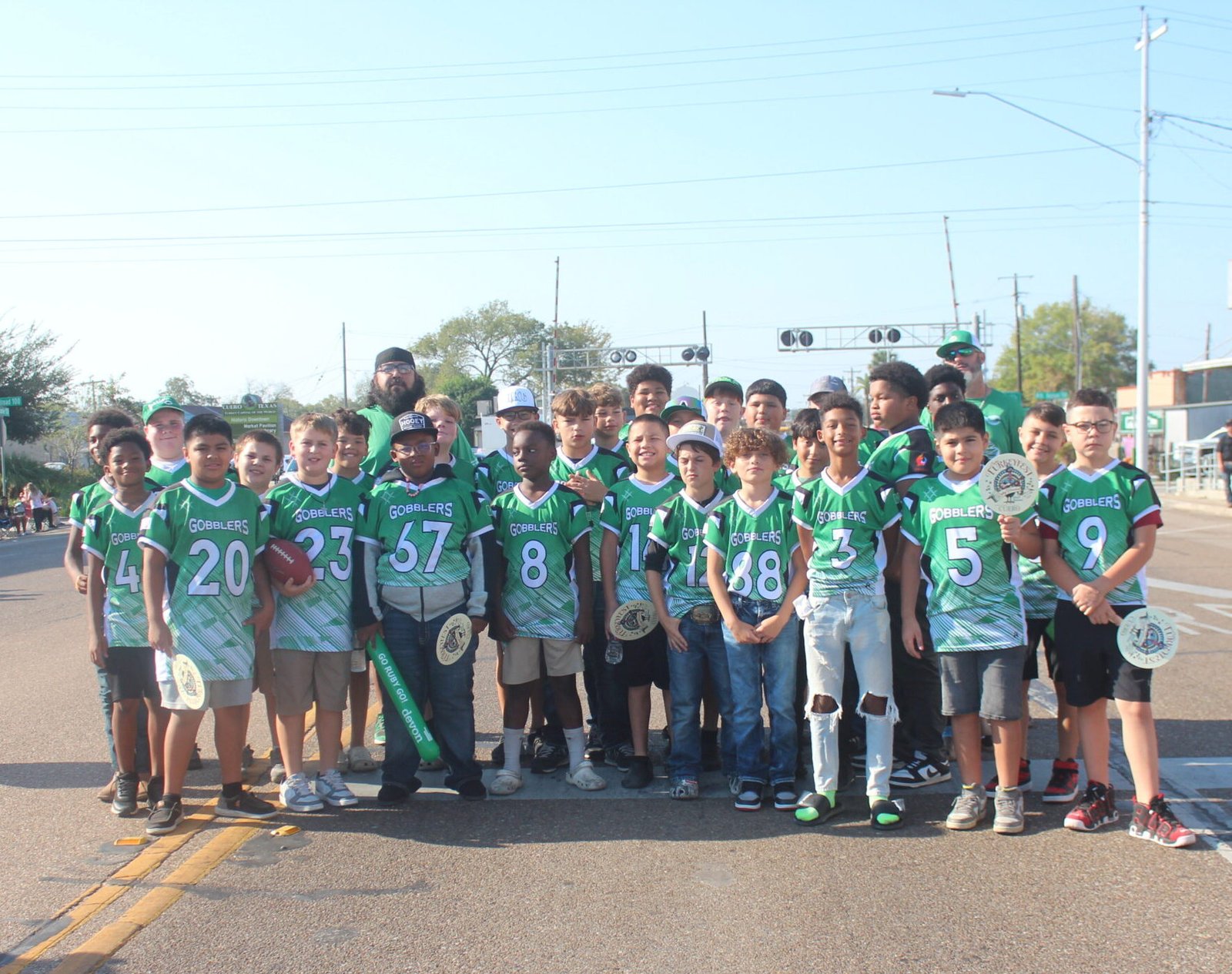
Young boys playing with their toys before the start of the Turkey Race and Parade
(Photo by Pat Trevino)
Crowd Waiting for the Turkey Race to Start
(Photo by Pat Trevino) The young man in the red shirt is pictured here with his grandparents. He’s come all the way from Seguin, Texas to watch the parade and to see our famous Turkey Race.
Cuero Turkey Fest offers its visitors a friendly and fun time
(Photo by Pat Trevino)
Worthington, Minnesota Paycheck Delegates
(Photo by Pat Trevino) Alfred and Roxann Polzine are with the Worthington Delegation from Worthington, Minnesota. They were given front row seats near the turkey race finish line.
Cuero Turkey Fest Where Strangers become friends
(Photo by Pat Trevino) – Cuero resident, Jose Trevino and Minnesota Delegate Alfred Polzine became fast friends. They met last year when they sat next to each other during last year’s Turkey fest race and parade. They have promised to meet at the same place for next year’s Turkey Fest.
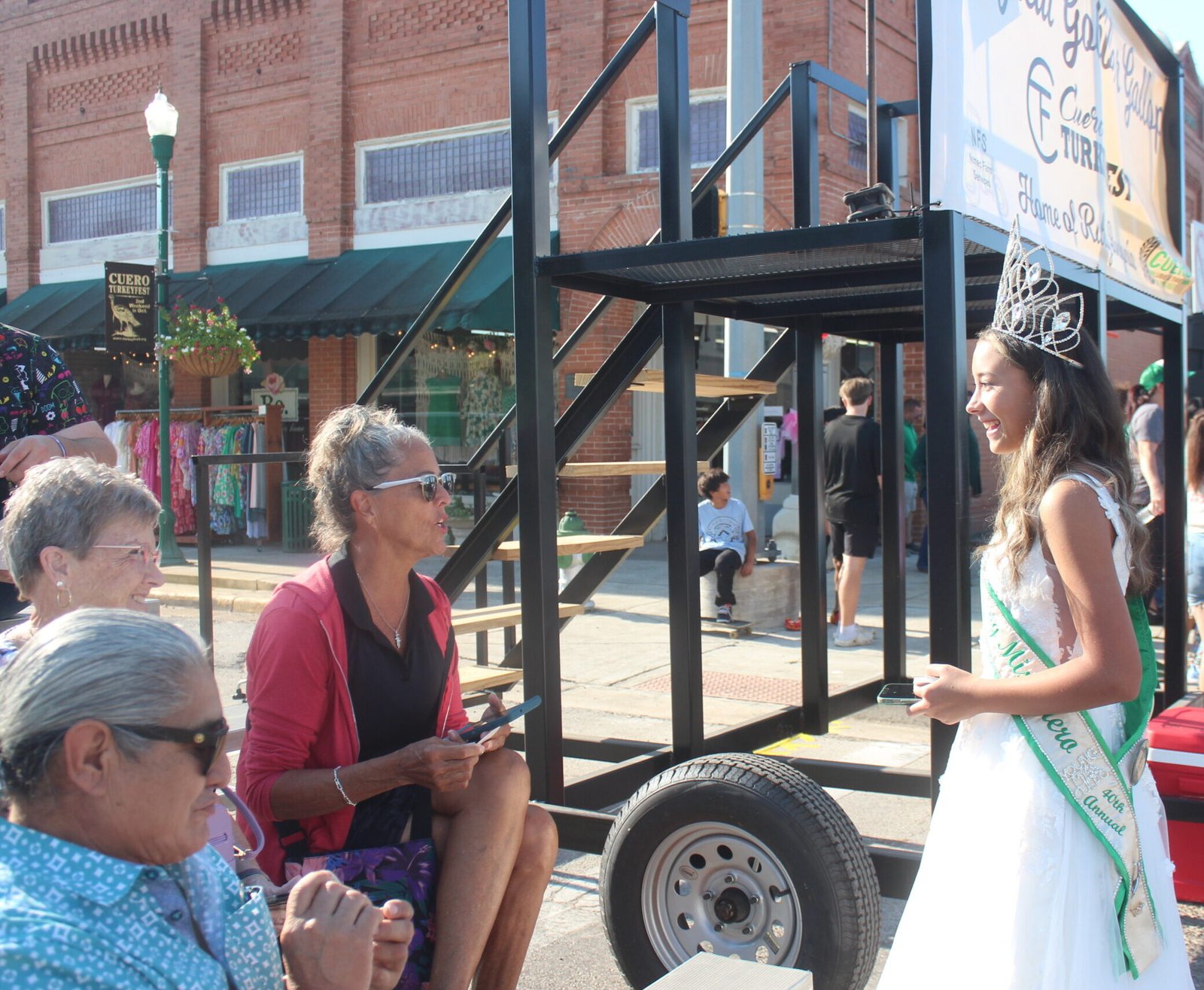
Cuero Royalty hands out Turkey Fest stickers
(Photo by Pat Trevino) – A delightful member of the Miss Cuero royalty court, added a special touch to the parade by distributing Turkey Fest stickers to attendees. In this photo, she’s with a Rockport resident and her mother who stayed overnight after the previous evening’s football game. The resident expressed her excitement about the Ruby Begonia and Paycheck turkey race, sharing that they’d always wanted to attend one of Cuero’s famous turkey races in person.Photo by Pat Trevino
Photo by Pat Trevino
Photo by Pat Trevino
Cuero Pays Respect to its Veterans
Photo by Pat Trevino
Pledge of Allegiance
Photo by Pat TrevinoPhoto by Pat Trevino
Microphone is handed over to Landri Dyer for the National Anthem
(Photo by Pat Trevino)- High School Student Landri Dyer sings the National Anthem. Landri has already won numerous awards for her singing ability.
Turkey Race Begins
(Photo by Pat Trevino) Gary Moses AKA – Brother Gary Moses of Victoria
Photo by Pat TrevinoPhoto by Pat TrevinoPhoto by Pat TrevinoPhoto by Pat TrevinoPhoto by Pat TrevinoPhoto by Pat Trevino(Photo by Pat Trevino)- And there she goes just a few feet from the finish line!!!
And The Winner is…RUBY BEGONIA!!!!
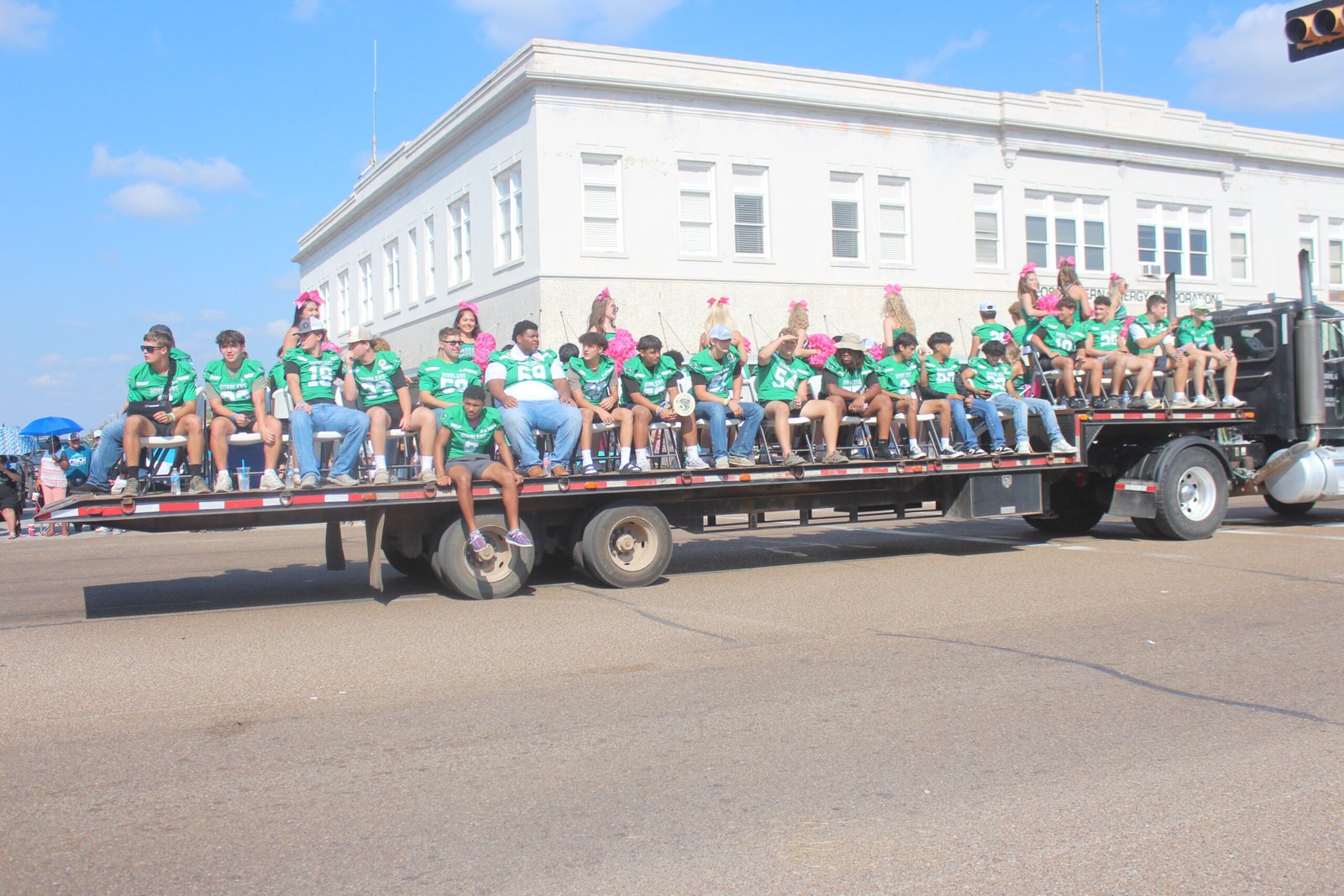
Photo by Pat TrevinoPhoto by Pat TrevinoPhoto by Pat Trevino(Photo by Pat Trevino) Cuero Varsity Football Team(Photo by Pat Trevino) Cuero High School Football Team
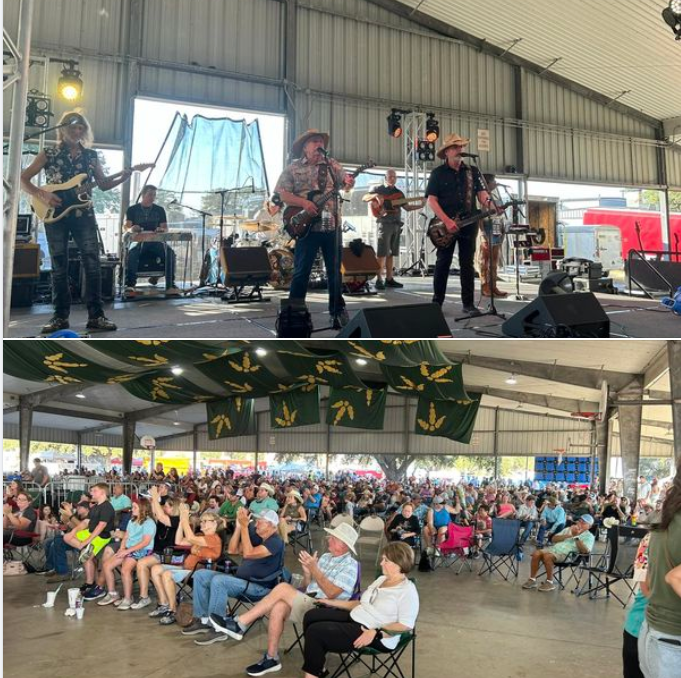
The Bellamy Brothers Perform at Park
Courtesy of Cuero Turkeyfest Official Event Page (For more information go to https://www.facebook.com/cueroturkeyfest)
The Turkey Egg Hunt
Courtesy of Cuero Turkeyfest Official Event Page (For more information go to https://www.facebook.com/cueroturkeyfest)
MORE PHOTOS OF EVENT COMING SOON….
Pat Trevino Freelance Blog Writer, Photographer, Published Author
The Cuero Citizen Police Academy Alumni Association Board and the Cuero Volunteer Fire Department co-sponsored the downtown pre-turkey race pancake breakfast. This free-to-the-public event turned out to be a heartwarming gathering, showcasing the town’s spirit and sense of community.
(photo by Pat Trevino) Left to Right Oscar Brazella, Brenda Arellano, and Steve Guerra
The aroma of freshly made pancakes and perfectly cooked sausage filled the air as attendees, both locals and visitors, lined up to enjoy a hearty breakfast. The pancakes were delicious—fluffy and golden brown, paired with tasty sausage that was cooked to absolute perfection.
(Photo by Pat Trevino) Janie Guajardo and Louis Guajardo
The breakfast drew several notable out-of-town guests, including Republican Candidate for TX-HD30 AJ Louderback who was with his family and friends.
Visitors from across Texas seized the opportunity to meet and mingle with locals. They interacted with some of the Cuero residents who had stopped by to enjoy the pancake breakfast: including Jose Luis Trevino and his grandson Easton, Janie and Luis Guajardo, Steve Guerra, Brenda Arellano, and Oscar Brazzel.
(Photo by Pat Trevino) Easton Keith and Jose Luis Trevino
Cuero’s own Councilman Terri Glover was one of the talented cooks behind the griddles, as well as Nicholas Taylor. Rhonda Stasney, Lori Lucas and Sherry Love were on hand to offer their assistance. They worked tirelessly to ensure everyone had a wonderful meal.
(Photo by Pat Trevino) Left to Right – Councilman Terry Glover and Nicholas Taylor
This event was more than just a meal; it was a celebration of community and camaraderie. Conversations flowed easily, laughter was abundant, and the shared experience brought everyone closer together. The Citizen Police Academy Alumni Association Board and the Cuero Volunteer Fire Department truly know how to create an unforgettable morning. As my husband always says, “Panza llena corazón contento.” (Full belly, happy heart 🙂 )
(Photo by Pat Trevino) Left to Right – Rhonda Stasney, Lori Lucas, and Sherry Love.
As we look forward to future events, let’s remember the joy that simple gatherings like the Pre-Race Pancake Breakfast bring to our lives. It’s these moments of connection and celebration that truly make Cuero a special place to live and visit.
Pat Trevino Freelance Blog Writer, Photographer, Published Author